



In today’s digital age, e-commerce marketplaces are all the rage. By 2040, a whopping 95% of purchases are expected to happen online. With this surge in e-commerce, the C2C (consumer-to-consumer) sector has seen remarkable growth. Yes, it presents a lucrative opportunity for revenue generation, but the competition looks daunting. But do you notice how even the giant marketplaces have loopholes? Well, if you have an idea but do not know how to get started with your own C2C marketplace development, you’ve stopped by the right place!
We’re here to guide you through each step of the journey, ensuring that you create a profitable C2C e-commerce marketplace that stands out from the crowd. But remember, successful C2C marketplace development is no walk in the park. It requires careful consideration of various aspects, including design, platform selection, and market strategy development.
So stop waiting and get started to learn these essentials. Read the blog to unravel the information and learn how to choose the best partner for your C2C marketplace software development.
What is a C2C Marketplace?
Though you may already know the meaning, getting the precise definition will help you get clarity.
In the ever-growing world of online commerce, a C2C marketplace is like a bustling digital bazaar where everyday people become entrepreneurs.
It’s a virtual meeting place where you can seamlessly connect to buy and sell products or services directly from one another. And guess what? You don’t even need any middlemen.
A customer-to-customer marketplace is also a platform to unlock hidden treasures. You connect with fellow enthusiasts and turn your spare items into someone else’s prized possessions. So, whether you’re searching for unique finds or looking to declutter, a C2C marketplace opens up a world of possibilities right at your fingertips.
How is C2C Marketplace Different from B2C and B2B?
Category | C2C Marketplace | B2C (Business-to-Consumer) | B2B (Business-to-Business) |
Participants | Individual customers as buyers and sellers | Businesses as sellers, individual customers as buyers | Businesses as both buyers and sellers |
Transaction | Customers directly buy/sell from each other | Customers buy from businesses | Businesses buy/sell goods or services to other businesses |
| Inventory | Individuals control their own inventory | Businesses control their own inventory | Businesses maintain and manage inventory |
Scale | Typically smaller scale transactions | Can be both small-scale and large-scale transactions | Primarily large-scale transactions |
| Relationship | Peer-to-peer interaction | Business-to-consumer interaction | Business-to-business interaction |
| Examples | Poshmark, Airbnb, Etsy | Amazon, Walmart, Best Buy | Alibaba, SAP, Cisco |

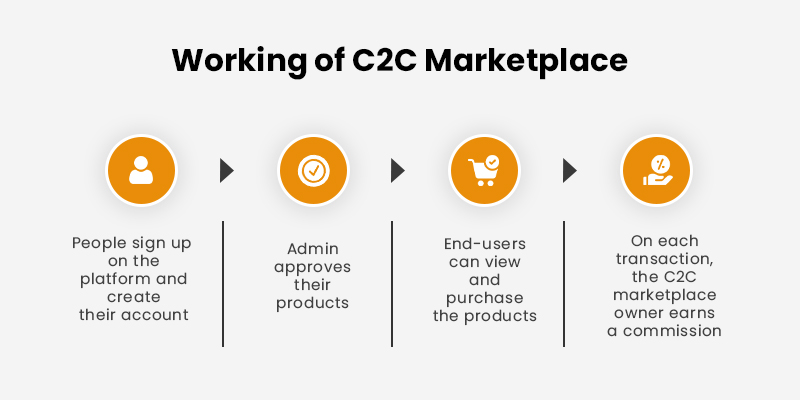
How Does C2C Marketplace Work?
It’s no rocket science. If you plan a simple user flow, you can ace the working of your ecommerce platform. Check out the below-given image to understand how:
Top C2C Marketplace Features to Consider for Users and Admin
Before we start talking about core development, let us tell you a secret. Consider adding unique features if you wish to set your platform apart in the crowded C2C market.
Yes, you read that right. Technology plays a crucial role, but at the end of the day, it’s all about what you offer. And only features can determine what you bring to the table. So, for starters, you can consider the below-given options.
A friendly reminder: Opt for custom marketplace development. The services will help you fit your specific business requirements with the platform.
C2C Marketplace Features for Users
 Search & Filters
 Search & Filters
Though a bit apparent, you just cannot miss search and filters in your C2C platform. Here, you can focus on optimizing user experience by offering them advanced search and filtering options. For instance, consider integrating voice and image search options to boost your marketplace’s convenience for users. Let them quickly narrow down their preferences and save time to enhance their overall shopping experience.
Promoted Listing
 Promoted Listing
This feature is for sellers coming to your platform to market their goods. Promoted listings will offer them the opportunity to showcase their products prominently. By allowing them to promote their listings, you increase the visibility of their items, giving them a competitive edge and increasing their chances of making successful sales.
Social Media Promoting
 Social Media Promoting
The power of word-of-mouth marketing in the digital age is quite significant. And nothing is better than social media for this purpose. So, ensure you allow your customers to effortlessly share their favorite products on Facebook, Instagram, or other platforms directly from your marketplace. Sharing will not only boost brand visibility but also tap into the vast potential of social networks. Ultimately, the engagement level of your platform will enhance, and you’ll be able to grow your traffic.
Communication Process
 Communication Process
This feature could define your C2C marketplace. Seamless communication channels connect buyers and sellers seamlessly. They facilitate interactions and let business flow. And when you give that to these 2 key parties, you will reduce the chances of misunderstandings. Hence the chances for returns or cancellations will also reduce. So, with this feature, you could create a win-win environment.
Account Management
 Account Management
Want to offer personalized experiences to both buyers and sellers? Include account management. Providing separate user accounts means you tailor email notifications, messages, and settings of your users. This will give you the power to engage them optimally. On the other hand, your users will enjoy using your platform when they will stay informed.
You can consider seeking AI development services to improve this feature. With AI algorithms, you can fine-tune and control the levels of user engagement.
Order Management
 Order Management
Most of the marketplaces now offer their users real-time updates on their orders. But the more detailed it is, the more traction your platform will likely get. So, you can customize order management by offering users location tracking, sending them push notifications, and more. Remember, if you can customize exactly how your audience wants it, it will lead you to delighted customers.
Ratings and Feedback
 Ratings and Feedback
Again, this feature is a staple for a C2C marketplace. With ratings and feedback, you show users that you value them regardless of what their opinion is. Plus, you also pave the way community-driven marketplace.
So consider implementing a comprehensive product rating system. Allow customers to share their feedback, positive or negative, creating a valuable feedback loop that boosts trust. It will also help other buyers make informed decisions and foster continuous improvement.

C2C Marketplace Features for Admin
Dashboards
 Dashboards
Ask your vendor to implement a comprehensive and intuitive admin dashboard. It will offer you real-time insights and the control to monitor the operations of your C2C marketplace.
This centralized hub allows you to manage the following efficiently:
- User activities
- Monitor transactions
- Make informed decisions for the growth of your platform, etc.
Content Management
 Content Management
Strive to have full control over your marketplace. For this, you’ll need a strong content management system. The system will ensure you can do the following:
- Manage and update product listings
- Ensure compliance with marketplace guidelines
- Swiftly remove any inappropriate or prohibited content, etc.
Product Management
 Product Management
Take charge of the products uploaded by your sellers with ease. With effective product management, you can create a safe and trustworthy environment for buyers and sellers alike. You can oversee the inventory to remove any illegal or prohibited items promptly. This way, you can maintain the integrity and compliance of your C2C marketplace.
User Management
 User Management
Get powerful tools for you to manage users effectively. Efficient user management will ensure you maintain a healthy and reputable user base. It will also help trust and loyalty among buyers and sellers. But for this, you must have the power to:
- Onboard new sellers
- Review and verify user profiles
- Monitor seller performance
- Address any issues or disputes that may arise, etc.
Secure Transactions
 Secure Transactions
Making users feel safe and confident about their transactions could add up to the USP of your C2C marketplace. And, for this, you can offer them multiple transactions, like cards, cash on delivery, and more. But more importantly, integrate secure payment gateways and robust fraud prevention measures.
When you take these steps, you can establish a trustworthy environment that safeguards sensitive information and protects users against fraudulent activities.
C2C Marketplace Development: Key Steps to Follow
A strategic C2C e-commerce marketplace development process can be a blessing if you’re an aspiring entrepreneur. And if you want to create an app, you should know a few key things before you jump right in.
First, you’ve got to understand your target audience and what they want. Second, you need a clear vision of how your app should work and look. These steps will definitely help you get started!
Step 1: Select Category
You have to figure out what kind of marketplace you want to make. You got two options: horizontal and vertical.
A horizontal one has all sorts of products from different categories, but it doesn’t specialize in any particular market. On the other hand, a vertical marketplace is all about focusing on one specific type for a targeted audience. It lets you showcase your products better and dominate that market.
Step 2: Plan to Build A Unique C2C Marketplace
Are you planning to build a unique C2C ecommerce platform? Well, trust is the name of the game in a competitive environment. When you prioritize trust, you turn customers into advocates, which boosts your brand’s visibility and attracts more folks, ultimately increasing your revenue. Besides this, be really specific about what you want to offer. This specific part can be a product niche, a unique user experience, or something else.
Step 3: Finalize Features
According to your business needs, finalize the features. Remember to focus both on user and admin functionalities while doing this. Also, much of your tech choices will depend upon this segment of your C2C platform development. So ensure you put your heart and soul into this step.
Step 4: Finalize Design
You should ensure your website looks snazzy too! A visually appealing design is key to grabbing user attention. Your layout, typography, images, and overall consistency should match your site’s purpose. Keep it simple for easy navigation and getting things done.
Also, ever heard of the Z-Pattern design? It’s a visual hierarchy trick that puts important elements front and center. You can go for popular platforms like Adobe Commerce, Shopify, Shopware, woo-commerce, and plenty more. Or you can choose a custom enterprise software development company to build your marketplace. Remember, the latter will give you enough room for customization and scalability that the former can lack.
Step 5: Select A Monetization Model
It’s time to consider the medium of revenue generation. The top monetization models for a C2C marketplace could be the following:
Commission Model
One way to make money with your marketplace is through commission fees. Basically, every time a user makes a transaction, you charge them a fee. You can collect these fees from the end customers, the artists, or both.
Subscription Model
Another option is to have recurring fees for accessing your marketplace. By charging users a smaller amount each month instead of a big lump sum, you can attract more people to your platform. Plus, with this model, you can have a better idea of your monthly revenue.
Listing Fee
With the listing fee model, users have to pay whenever they post an offer. It’s different from the commission model because you charge them for posting, not just when they sell something. The listing fees are usually small and cheaper than subscriptions. Sometimes, earning enough revenue from this model can be challenging, so having a secondary model is a good idea.
Step 6: Collaborate for Core C2C Marketplace Development
First things first, ensure you collaborate with a vendor with outstanding digital transformation services. This step will help you tackle multiple challenges associated with development and maintenance.
Next up, team up with your vendor closely. Yes, you should do that anyway. But during this step, that should be your key focus. It’s because you finalize your app’s infrastructure, working, functionality, and almost every critical aspect by choosing the right technology. That said, let us look at some of the tech options you have for different elements of your platform.
| Category | Tech Options |
| Programming languages | JavaScript, HTML5, Ruby, CSS3, Python |
| Application framework | Ruby on Rails, Django |
| Automation frameworks | Capybara, RSpec, PhantomJS, Selenium |
| Data Storage | PostgreSQL, MySQL, MongoDB |
| Key-Value Storage | Redis, Memcached |
| Web server | Nginx, Apache |
| Web Application Server | Puma, Unicorn, Gunicorn |
| Hosting | Amazon Web Services (AWS), Google Cloud Platform (GCP), Microsoft Azure |
Step 7: Ensure Testing and Monitoring
Ensure you have a solid plan in place to test your C2C marketplace. Also, thoroughly keep an eye on its performance. Testing helps you catch issues before they reach your users, ensuring a smooth experience.
Monitoring allows you to track the platform’s real-time performance. It keeps you rest assured everything runs smoothly. So, don’t skip this crucial step and keep your marketplace in tip-top shape!
Why Choose Matellio for C2C Marketplace Development?
You no longer need to wander to find the best C2C marketplace software development partner when you reach our door. At Matellio, we believe in holding our client’s hands from the inception of their business idea to long-term support. Whether it’s development, design, or deployment, our team stays at their service by guiding them during each step of the project cycle. So what are you waiting for? Take advantage of cost-effective and agile development services. Learn more about our comprehensive services now!