



For U.S. commercial banks in the $10B–$100B asset range, the phone channel has quietly become the softest attack surface in the institution. Fraud teams have hardened online and mobile banking with device fingerprinting and step-up authentication, but the contact center still leans on caller ID and knowledge-based questions — controls that AI voice cloning now defeats in seconds. This guide, part of Matellio’s Voice Security for Banks coverage, breaks down the two halves of the problem, compares them side by side, and shows why a bank needs coverage on both.
Why contact center fraud is a board-level problem in 2026
Voice fraud stopped being a niche concern the moment generative AI made a convincing voice clone cheap and fast. The numbers now land squarely on the CISO and Chief Risk Officer:
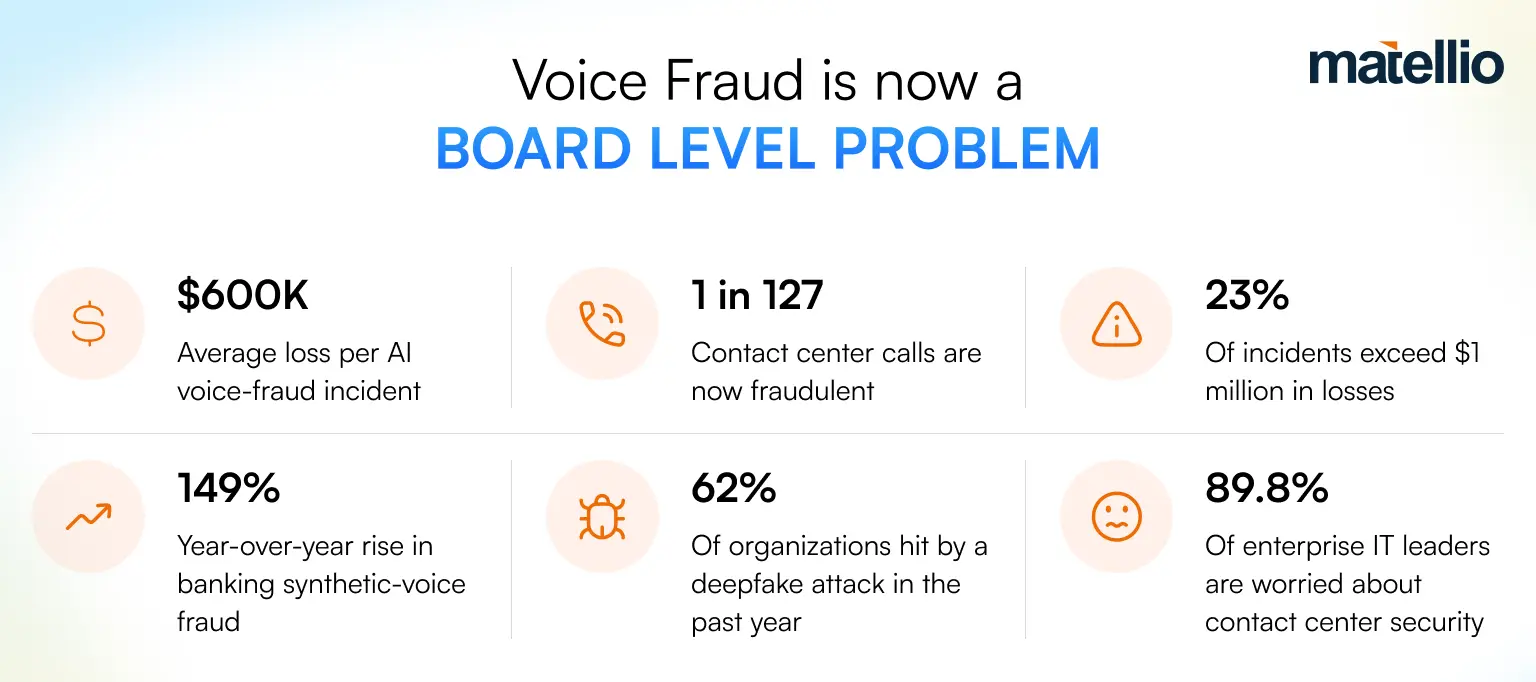
Two vendor changes have turned this from a slow-burn risk into a live gap. AWS ended support for Voice ID in Amazon Connect on May 20, 2026, after cutting off new customers back in May 2025, and Microsoft retired Azure Speaker Recognition in September 2025. Any bank that relied on either has already lost that capability and is running without a replacement today.
Inbound spoof detection vs. outbound call authenticity: the core distinction
The single most useful mental model for contact center fraud prevention is direction of travel. Every voice-channel control protects either the calls coming in or the calls going out — and the threats, technologies, and owners are almost entirely different on each side.

What is inbound spoof detection?
Inbound spoof detection is the practice of scoring and screening calls arriving at the bank’s contact center to identify spoofed caller IDs, synthetic or cloned voices, and other high-risk signals before a fraudster reaches a live agent or the IVR. It protects the bank and its account holders from impostors calling in.
What is outbound call authenticity (and phone spoofing prevention)?
Outbound call authenticity is the practice of proving that a call placed by the bank genuinely originates from the bank — through branded caller ID, verified/attested calling (STIR/SHAKEN), and consistent number reputation. It is the phone spoofing prevention that stops criminals from impersonating the bank to customers, and stops legitimate fraud-alert calls from being silently blocked as “Spam Likely.”
Side-by-side comparison
Here is how the two halves of contact center fraud prevention compare across the dimensions that matter to a bank’s security, fraud, and contact center teams:
| Dimension | Inbound Spoof Detection | Outbound Call Authenticity |
|---|---|---|
| Problem solved | Impostors calling INTO the bank reach agents or the IVR | Criminals impersonate the bank when calling OUT to customers |
| Primary threat | Caller-ID spoofing, deepfake/synthetic voice, account-takeover vishing | Brand impersonation, “Spam Likely” mislabeling of real calls |
| Who is protected | The bank and its account holders from inbound fraud | Customers and the bank’s brand and answer rates |
| Key technologies | Call risk scoring, spoof/ANI validation, voice biometrics, deepfake detection | Branded caller ID, verified/attested calling, STIR/SHAKEN A-attestation |
| Signals used | Network/carrier metadata, audio forensics, behavioral & voiceprint analysis | Cryptographic call signing, number reputation, registered brand identity |
| Regulatory driver | OCC / Federal Reserve exams on AI-enabled fraud controls (e.g., OCC Bulletin 2023-17) | STIR/SHAKEN framework and enterprise call-branding standards |
| Owner in the bank | CISO, CRO, Head of Fraud | VP Contact Center, VP Customer Experience, CMO |
| Failure mode if absent | Fraudsters authenticate as customers; account takeover losses | Fraud alerts go unanswered; customers fall for spoofed “bank” calls |
| Business metric | Fraud loss per incident, % of fraudulent calls caught | Outbound answer rate, % of calls mislabeled as spam |
Takeaway: inbound spoof detection is a security/fraud function; outbound call authenticity is a customer-experience and brand function. A bank that invests only in one leaves half the phone channel exposed.
How does phone spoofing prevention actually work?
Phone spoofing prevention (also called telephone spoofing prevention) works differently depending on direction, because the attacker’s goal differs on each side.
On inbound calls
The platform inspects each call in real time and assigns a risk score before it is routed. It validates whether the displayed number is consistent with the underlying network signaling (spoof and ANI validation), analyzes the audio for signs of synthetic or cloned speech (deepfake detection), and can compare the caller’s voiceprint against enrolled fraudsters or known-good customers. High-risk calls are flagged, challenged, or routed to a specialist queue instead of straight to an agent who trusts caller ID.
On outbound calls
The bank registers its calling numbers and brand identity, then signs each outbound call so carriers can cryptographically attest that it truly came from the bank (STIR/SHAKEN A-attestation). Customers see a verified, branded caller ID — the bank’s name and logo — instead of an unknown number. This both blocks criminals from convincingly spoofing the bank and stops the carrier analytics engines from mislabeling legitimate fraud alerts as spam.
The outbound blind spot most banks miss
42% of businesses have their legitimate outbound calls mislabeled as “Spam Likely” or “Scam Risk.” When a fraud-alert call goes unanswered, the customer may not learn about the fraud for days — turning an outbound-calling failure into a downstream fraud loss and a liability question. Branded calling raises answer rates by up to 200%. (Bandwidth 2025; First Orion)
Why knowledge-based authentication no longer protects banks
Knowledge-based authentication (KBA) — “confirm your date of birth and the last four of your SSN” — is still the dominant inbound verification method at most banks. It is now trivially defeated. Data breaches have made the answers cheap to buy, and AI voice cloning lets a fraudster deliver those answers in a customer’s own voice. Worse, fraud that begins in the IVR or with an agent can spread cross-channel into online and mobile banking. Any modern contact center fraud prevention program has to treat KBA as a speed bump, not a control, and layer real signals — call risk, spoof detection, and deepfake analysis — underneath it. (Bandwidth, 2025)
Why banks need both inbound and outbound protection
Inbound and outbound controls close different doors. Strong inbound spoof detection stops an impostor from talking their way into an account, but does nothing when a fraudster spoofs the bank’s own number to call a customer. Strong outbound authenticity protects the brand and answer rates, but does nothing when a deepfake caller dials into the contact center. Treating them as one purchase — with one owner and one budget line — is how banks end up half-covered. Treating them as a single layered program, with the fraud team and the contact center team aligned, is how the whole phone channel gets protected.
A layered approach: how Matellio OCCAS fits
Matellio’s OCCAS servcies is built to cover both directions of the phone channel without ripping out a bank’s existing telephony. It orchestrates best-in-class capabilities as an overlay above your current SIP infrastructure — no rip-and-replace — across three layers:
- Layer 1 — Inbound Call Protection: spam/fraud/robocall detection, spoofed-number identification, risk-based routing, and synthetic-voice & deepfake detection.
- Layer 2 — Outbound Call Integrity: branded caller ID, verified outbound calling, STIR/SHAKEN A-attestation, and fraud-alert delivery workflows.
- Layer 3 — AI Digital Voice Agent: conversational AI for inbound handling, intelligent dynamic routing, and IVR modernization across the contact center.
Because OCCAS deploys above existing SIP infrastructure, banks can add inbound spoof detection and outbound call authenticity without replacing their contact center platform — and can start with whichever gap is most urgent, whether that is an AWS Voice ID retirement deadline, a board-level deepfake mandate, or falling outbound answer rates. For banks already planning their migration off Voice ID, this is also a natural moment to revisit the broader Amazon Connect migration roadmap so authentication and platform modernization happen together.

FAQ’s
1. What is contact center fraud prevention?
2. What is the difference between inbound spoof detection and outbound call authenticity?
3. How do banks prevent phone spoofing?
4. Does STIR/SHAKEN stop caller-ID spoofing?
5. Can voice biometrics detect deepfake or cloned voices?
6. How much does contact center fraud cost banks?
References
- Gartner (Sep 2025, n=302) — deepfake attack prevalence — https://www.gartner.com/en/newsroom/press-releases/2025-09-22-gartner-survey-reveals-generative-artificial-intelligence-attacks-are-on-the-rise
- OCC Bulletin 2023-17 — AI-enabled fraud and voice-channel risk — https://www.occ.gov/news-issuances/bulletins/2023/bulletin-2023-17.html
- AWS Amazon Connect Voice ID end of support notice (May 2026) — https://docs.aws.amazon.com/connect/latest/adminguide/amazonconnect-voiceid-end-of-support.html
- Microsoft Azure AI Speaker Recognition retirement notice (Sep 2025) — https://azure.microsoft.com/en-us/updates?id=azure-ai-speaker-recognition-retirement
Author Bio

VP- Account Management at Matellio


