


Voice Security & AI for Contact Centers
Make your existing contact center AI-ready without replacing a single thing you run today.
Go live in 6–8 weeks, at a fraction of what a platform replacement would cost.







DEPLOYED FOR


+1,300%
+149%
87%
$44.5B
What We Deliver
Three capabilities. One deployment.
Each capability runs on the same Oracle OCCAS layer. Deploy one to address your most urgent risk, or all three — no separate integrations, no separate contracts.
INBOUND
Inbound call protection
Every inbound call screened at the SIP layer before it reaches an agent. Robocalls, spoofed ANIs, and AI-generated voices stopped before they touch queue capacity.
- Call filtering & ANI spoof detection
- Passive voice biometrics — no PIN, no prompt
- Real-time deepfake & synthetic voice detection
- Risk-based routing to fraud specialists
OUTBOUND
Outbound call integrity
Your fraud alerts showing as “Spam Likely” means customers never act on them. We restore your outbound identity at the SIP layer — before the call hits the carrier network.
- Branded caller ID — name, logo, call reason
- STIR/SHAKEN A-attestation, cryptographic call signing
- Rich Call Data injection, no carrier change required
- Number reputation monitoring + automated remediation
AUTOMATION
AI digital voice agent
- Natural-language IVR replacement, no press-1 menus
- Intent detection + CRM lookup before routing
- First-call resolution with skill-based routing
- Any LLM or voice-AI vendor connectable via OCCAS
Matellio at a Glance
Proven at scale. Deployed in production.

DEPLOYED FOR
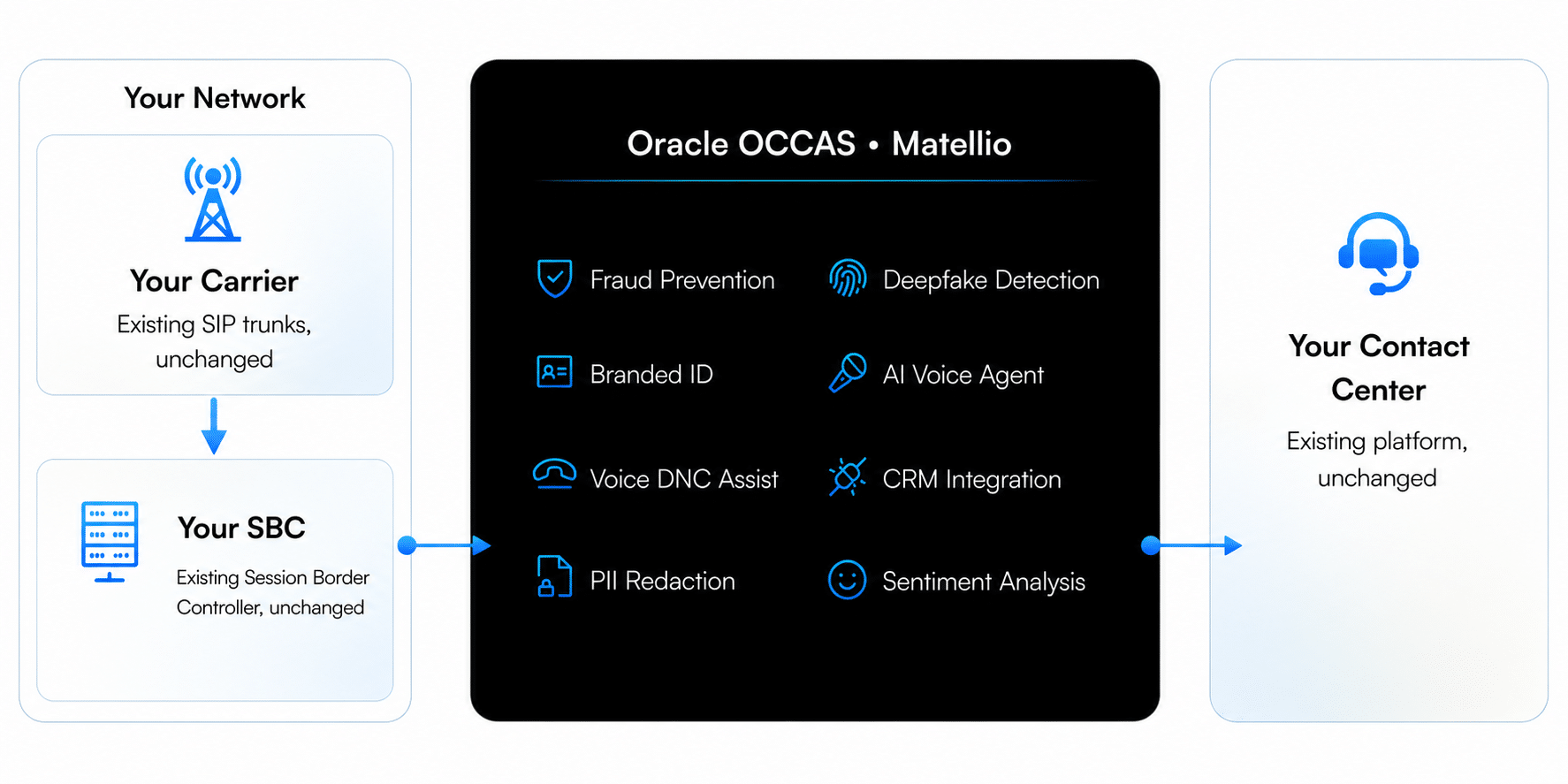
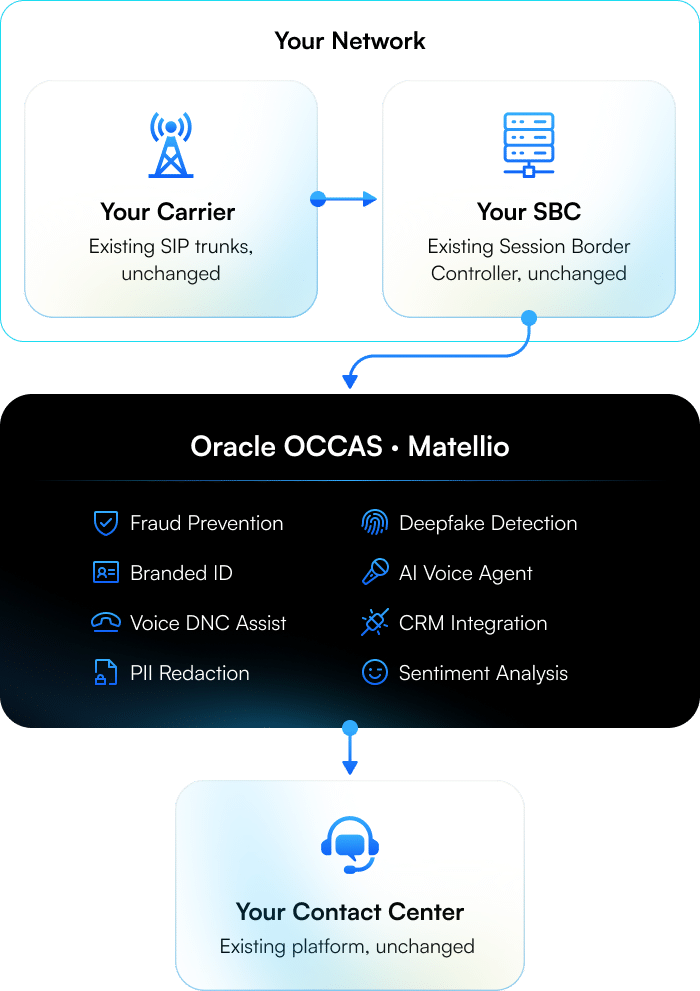
Architecture
One layer above your stack. Nothing changes below it.
Oracle OCCAS deploys above your existing SIP infrastructure. Your carrier, phone system, and contact center stay exactly as they are.





Why Matellio
A partner committed to your success—not just your implementation.
Nothing gets replaced
OCCAS deploys above your existing SIP stack. Carrier, phone system, contact center — all unchanged.
Easy to expand, easy to build on
Your first capability builds the foundation. Every capability after that deploys faster and at a fraction of the initial cost.
Built for bank compliance
On-prem, private-cloud, or hybrid deployment. Aligned to FFIEC, OCC, and FDIC voice channel requirements.
Live in 6–8 weeks
A published deployment schedule. Core OCCAS in 6–8 weeks; each additional capability adds 2–3 weeks.
Right-sized for your institution
Start with one capability against your most urgent risk. Built for community banks and credit unions through to enterprise.
Delivered end-to-end
Matellio owns integration, deployment, and support from a single point of accountability — no vendor coordination required on your end.
What Customers Say
Deployed where infrastructure can't be replaced.
“We had a fully paid-off on-prem system and no appetite for cloud licensing costs. Matellio got call branding, fraud detection, and an AI agent live in under three months — without touching our existing phone system or carrier contract.”
Frequently Asked Questions
What is Oracle OCCAS and what is it used for?
Oracle Communications Converged Application Server (OCCAS) is a carrier-grade, standards-based SIP and HTTP application server for building real-time communications applications. Telecom operators and enterprises use it to deploy voice, messaging, and signaling services, and increasingly to orchestrate Voice AI and security across networks and contact center platforms without replacing existing infrastructure.
How does OCCAS work as an orchestration layer for Voice AI?
How does OCCAS help prevent voice fraud, deepfakes, and AI voice-cloning attacks?
Carriers flag numbers that lack verified identity signals. Matellio fixes this with STIR/SHAKEN A-attestation (cryptographic call signing), First Orion branded caller ID, and continuous number reputation monitoring. Branded calling typically lifts answer rates by up to 200% — the difference between a customer catching fraud today or days later.
How does OCCAS integrate with existing contact center platforms like Genesys, NICE, Cognigy, and Avaya?
How does OCCAS integrate with Session Border Controllers (SBCs) and carrier SIP trunks?
Is OCCAS-based Voice AI compliant with HIPAA, PCI-DSS, and SOC 2?
How long does an OCCAS implementation take?
How much does an OCCAS Voice AI implementation cost?
What's the difference between buying a CCaaS solution and orchestrating Voice AI through OCCAS?
Why choose Matellio as your OCCAS implementation partner?
Can OCCAS scale to carrier-grade volumes and guarantee high availability?
See exactly where your voice channel is exposed.
A 30-minute voice security assessment with our team. We walk through your current inbound and outbound posture, identify the gaps, and show how OCCAS closes them — no pitch deck, no obligation.