




Why settle for mere numbers when you can unlock the secrets they hold?
Ever wonder about the goldmine hidden in your data? It’s not just numbers; it’s the pulse of your business, the key that opens up the untapped potential. But let’s face it: sorting through this data jungle can be daunting. That’s where enterprise reporting software swoops in as the hero of the story.
In a world where data rules supreme, enterprises needed a way to make sense of the chaos. Enter stage left: enterprise reporting software, the ultimate problem solver. No more drowning in spreadsheets or drowning in charts. It’s about time-saving, decision-boosting magic.
Fast forward to today, and the demand for this software isn’t just on the rise; it’s skyrocketing. Businesses big and small are realizing the power of data-driven insights. And with each passing day, enterprise reporting software isn’t just a tool; it’s the driving force behind smarter decisions and brighter futures.
Ready to take your business to the next level? Say goodbye to guesswork and hello to data-driven decision-making with enterprise reporting software development. It’s not just about writing code; it’s about crafting solutions that propel your business forward.
Whether you’re a seasoned developer looking to refine your skills or a business owner eager to unlock the full potential of your data, this is the best time. Read on to dive deep into the captivating world of enterprise reporting software development. Or, if you want to skip the reading, our doors are always open for 30-minute free consultation, fill the form right away and let’s talk!
Starting with the basics first.
What Is Enterprise Reporting Software and Why Is It Important?
Enterprise reporting software is a powerful tool designed to gather, organize, and analyze data from various sources within an organization, presenting it in a comprehensible format for decision-making purposes. It goes beyond basic data visualization by providing detailed insights and customizable reports tailored to the specific needs of businesses.
The importance of enterprise reporting software lies in its ability to transform raw data into actionable intelligence, enabling businesses to make informed decisions quickly and efficiently.
Think of it this way: your business is a puzzle, and data is the missing piece. Enterprise reporting software swoops in to complete that puzzle, painting a clear picture of your operations, finances, customer behavior, and more. With this tool in your arsenal, you’re not just making decisions; you’re making informed decisions, backed by solid data.
Let’s not forget the simplicity it brings to the table. No more drowning in spreadsheets or scratching your head over complex reports. With enterprise reporting software, insights are just a few clicks away, presented in a way that even the least tech-savvy person in the room can understand.
And here’s the kicker: In today’s fast-paced digital landscape, where every company is vying for a competitive edge, digital transformation services are the name of the game. And guess what? Enterprise reporting software is at the heart of it all, driving efficiency, innovation, and growth like never before.
So, if you’re ready to take your organization to new heights, then enterprise reporting software development is your ticket to success.
Let’s see the numbers now!
Enterprise Software Market Statistics for Better Decisions
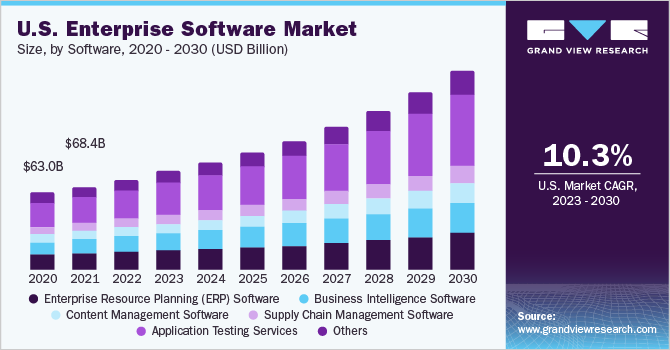
The enterprise reporting software market is booming, thanks to powerful market drivers that are reshaping how we manage data and make decisions. Let’s dive into the numbers and uncover what’s fueling this exciting growth.
The size of the global enterprise software market is projected to grow at a compound annual growth rate (CAGR) of 10.3% from 2023 to 2030.
Market Drivers:
Data Explosion:
The exponential growth of business data is propelling the demand for enterprise reporting solutions, as organizations seek effective solutions to manage and analyze large volumes of information.
Real-Time Insights:
The need for instant access to actionable insights is driving the adoption of enterprise reporting software, enabling businesses to make informed decisions swiftly in response to changing market conditions.
Business Intelligence Focus:
Increasing recognition of the importance of data-driven decision-making is fueling the demand for advanced business intelligence tools like enterprise reporting software, which provide valuable insights for strategic planning and performance optimization.
Regulatory Compliance:
Stringent regulatory requirements necessitate robust data governance and reporting solutions. Enterprise reporting software offers features for compliance reporting and data security, helping organizations adhere to regulatory mandates.
Cloud Adoption:
The shift towards cloud-based solutions is reshaping the enterprise reporting software market, with cloud deployment offering scalability, flexibility, and cost-effectiveness, making reporting solutions accessible to businesses of all sizes.
Integration of Advanced Technologies:
Incorporation of AI, ML, and NLP technologies enhances the capabilities of enterprise reporting software, enabling predictive analytics, anomaly detection, and automated report generation, thus augmenting its value proposition.
Each of these market drivers acts as a turbo boost for the enterprise reporting solutions market, catering to the varied needs of businesses in our data-centric universe.
Major players include Microsoft (Power BI), Tableau Software, SAP (BusinessObjects), Oracle (Hyperion Enterprise Performance Management) and IBM (Cognos Analytics)
All-in-all, Enterprise Reporting Software is the ultimate tool for businesses seeking to harness the power of data for informed decision-making, streamlined operations, and competitive advantage.
But wait, isn’t that just like Business Intelligence? Not quite! Let’s delve into the nuances and uncover the real differences!
Difference Between Enterprise Reporting and Business Intelligence
The main difference between enterprise reporting and business intelligence lies in their focus and scope. Enterprise reporting typically involves generating predefined reports based on structured data from various sources within an organization, providing standardized views of performance metrics and operational data.
On the other hand, business intelligence (BI) encompasses a broader set of tools and processes aimed at analyzing and interpreting data to uncover trends, patterns, and insights that drive strategic decision-making. While enterprise reporting is more about presenting historical data in a structured format, business intelligence involves deeper analysis and exploration of data to support informed decision-making and strategic planning.
At Matellio, we specialize in the development of both enterprise reporting and business intelligence solutions, tailored to meet your specific needs and preferences. Whether you’re looking for standardized reports to streamline operations or advanced analytics for strategic insights, our enterprise solutions have got you covered. Let us guide you through the nuances of each, ensuring clarity and confidence in your data-driven journey.
Ready to Transform Your Data?
Contact Us for a Custom Reporting Solution!
Why You Should Consider Investing in Enterprise Reporting Software
Considering an investment in enterprise reporting software? Here’s why it’s a game-changer.
In today’s fast-paced business world, data is king. But without the right tools to harness its power, you’re left in the dark. Enter enterprise reporting software – your beacon of light in the data jungle. It centralizes your data, crunches the numbers, and serves up actionable insights on a silver platter. With it, you’ll make smarter decisions, spot trends before they happen, and stay steps ahead.
Beyond short-term gains, enterprise reporting software development offers long-term benefits such as increased competitiveness, improved customer satisfaction, enhanced regulatory compliance, and greater strategic alignment. It provides a solid foundation for sustainable growth and success in today’s dynamic business environment.
| Challenges Before Enterprise Reporting Software Development | Solutions After Implementation |
| Manual data collection and reporting processes | Automated data integration and reporting workflows |
| Disparate data sources and siloed information | Centralized data repository and unified reporting platform |
| Time-consuming report generation and analysis tasks | Real-time data access and interactive dashboards |
| Limited visibility and insights into business performance | Advanced analytics capabilities for predictive modeling and trend analysis |
| Inconsistent reporting formats and lack of standardization | Customizable report templates and standardized reporting practices |
| Difficulty in tracking KPIs and monitoring performance metrics | Key performance indicators (KPIs) dashboards and performance tracking tools |
Don’t let data chaos hold you back. With enterprise reporting systems, you can harness the full power of your data and propel your business to new heights. Let’s chat about how we can tailor a solution just for you and revolutionize the way you do business. Together, we’ll turn your data challenges into opportunities for GROWTH and SUCCESS.
Features That Can Make a Good Reporting Software
Crafting a robust enterprise reporting software involves integrating key features that streamline data management, enhance usability, and deliver actionable insights. Here are essential features to consider for your enterprise reporting software development:
 Drag-and-Drop Interface:
Simplify report creation with a user-friendly drag-and-drop interface. Adding this feature can empower users to effortlessly arrange and visualize data, streamlining the reporting process. With intuitive controls, even beginners can create professional-looking reports in no time.
 Customizable Templates:
Tailor reports to specific needs with customizable templates. This will allow users to personalize their reports, enhancing flexibility and efficiency in data presentation. By providing a range of templates, users can easily create professional reports that meet their unique requirements.
 Real-Time Data Updates:
Keep reports current with real-time data integration. This feature ensures that insights are always accurate and up-to-date, enabling timely decision-making. With real-time updates, users can act on the latest information with confidence, driving better business outcomes.
 Interactive Charts and Graphs:
Bring data to life with interactive charts and graphs which will make insights easier to understand for users. Having interactive elements can quickly help in identifying key insights and making informed decisions.
 Automated Report Scheduling:
Save time with report automation. This feature allows users to set up regular report generation and distribution, reducing manual effort. By automating the reporting process, users can ensure that stakeholders receive timely updates without constant supervision.
Also Read: Report Automation Software – Features, Development Process, and Cost
 Mobile Accessibility:
Stay informed on the go with mobile accessibility. Your users will be able to access reports from any device, increasing flexibility and collaboration. Mobile access will allow them to make informed decisions anytime, anywhere, enhancing productivity and responsiveness.
 Role-Based Permissions:
Ensure data security with role-based permissions. This feature controls access to sensitive information, reducing the risk of unauthorized access. By assigning permissions based on roles, users can protect valuable data assets and maintain compliance with regulations.
 Drill-Down Functionality:
Dive deeper into data with drill-down functionality. Let users explore details and uncover insights at a granular level with this feature, enhancing analysis capabilities. With drill-down options, users can investigate trends and anomalies with ease, driving deeper understanding and better decision-making.
 Filtering and Sorting Options:
Fine-tune reports effortlessly with filtering and sorting options, zeroing in on what truly matters. This turbocharges usability and efficiency, empowering users to spot trends and insights with ease. With flexible capabilities, every report becomes a tailored masterpiece, supercharging decision-making like never before.
 Exporting and Sharing Capabilities:
Spread insights like wildfire with exporting and sharing capabilities, ensuring no valuable nugget of information goes unnoticed. Seamlessly export reports in various formats and share them across platforms, fostering collaboration and alignment. It’s the key to ensuring insights land in the right hands at the right time, igniting teamwork and driving results.
 Data Governance Tools:
Fortify data integrity and compliance with governance tools that instill trust in every byte of information. By embedding this feature, you bolster confidence in the accuracy and reliability of reports, paving the way for sound decision-making grounded in solid data foundations.
 Integration with External Systems:
Forge seamless connections with external systems, harmonizing data flow and amplifying reporting efficiency. This game-changing feature centralizes data management and slashes manual efforts, unleashing a new era of precision and agility in reporting processes.
 Multi-Language Support:
Speak the language of global users with multi-language support, breaking down barriers to accessibility and usability. By embracing this feature, you ensure that every user, regardless of location, can wield the software effectively, empowering organizations to thrive on a global scale.
 Feedback and Collaboration Tools:
Cultivate a culture of collaboration and innovation with feedback and collaboration tools that spark dialogue and creativity. By infusing this feature, you foster engagement and unity, empowering users to pool their expertise and drive towards shared objectives with unwavering momentum.
By weaving these features into your enterprise report management software, you’re not just building a tool—you’re crafting a data-driven powerhouse! As your trusted enterprise software development company, we’re here to guide you on this journey. Let’s unlock the true value of your data and drive business success together!
Get Exclusive Features Added to Your Enterprise Reporting Software with Our Experts!
Technology Trends to Follow for Enterprise Reporting Software
Staying ahead in the realm of enterprise reporting software means keeping a keen eye on emerging technology trends. This will not only give you a competitive edge but also ensure that your reporting solutions remain relevant and impactful in today’s rapidly evolving business landscape.
Here are some key trends:
AI and Machine Learning Integration:
Integrate AI and machine learning algorithms into your enterprise reporting software to enable advanced analytics, predictive modeling, and automated insights generation. With AI reporting software development, you can uncover hidden patterns and make data-driven decisions with greater accuracy and speed.
Natural Language Processing (NLP):
NLP technology allows users to interact with reporting software using natural language queries, making data analysis more accessible to non-technical users. By incorporating NLP capabilities, you can provide intuitive and conversational interfaces, enhancing user experience and adoption.
Augmented Analytics:
Embrace augmented analytics, which combines AI, machine learning, and natural language processing to automate data preparation, insight generation, and visualization. This lets users uncover insights and trends in real-time, driving faster decision-making and empowering your team to become citizen data scientists.
Data Visualization Enhancements:
Adopt advanced data visualization techniques, such as augmented reality (AR) and virtual reality (VR), to transform the way you interact with data. By incorporating immersive visualization capabilities, you can gain deeper insights and facilitate more engaging data exploration experiences.
Edge Computing:
Edge computing brings data processing closer to the source of data generation, enabling real-time analysis and insights at the edge of the network. Integrating edge computing capabilities into enterprise reporting software allows organizations to analyze and act on data in real-time, even in remote or bandwidth-constrained environments.
Blockchain for Data Security:
Blockchain technology offers enhanced security and transparency for data transactions, making it ideal for ensuring the integrity and authenticity of enterprise reporting data. By leveraging blockchain for data security, enterprise reporting software can provide tamper-proof audit trails and secure data sharing across organizational boundaries.
Cloud-Native Solutions:
Cloud-native architecture enables scalability, agility, and cost-efficiency for enterprise reporting software deployments. By embracing cloud-native solutions, organizations can leverage on-demand resources, automated scaling, and continuous delivery to accelerate innovation and stay competitive in a rapidly evolving landscape.
Hybrid and Multi-Cloud Deployments:
Hybrid and multi-cloud deployments allow organizations to leverage the best of both worlds by combining on-premises infrastructure with public and private cloud services. By supporting hybrid and multi-cloud architectures, enterprise reporting software can provide flexibility, resilience, and scalability to meet diverse business needs and regulatory requirements.
Staying in sync with these tech trends is a must for companies aiming to get the most out of their enterprise reporting software investments and lead the pack in today’s data-centric era. Embracing these new technologies and tapping into AI development services opens doors to fresh opportunities, fuels innovation, and supercharges your ability to gather insights and make swift decisions.
Popular Applications of Enterprise Reporting Software
Enterprise reporting software finds widespread applications across various industries and organizational functions. Here are some popular applications:
Financial Reporting:
Enterprise reporting software is extensively used for financial reporting, including generating balance sheets, income statements, cash flow statements, and other financial metrics. It helps organizations analyze their financial performance, track expenses, and make informed decisions about budgeting and resource allocation.
Sales and Marketing Analytics:
Enterprises leverage reporting software to track sales performance, analyze customer data, and measure marketing campaign effectiveness. It provides insights into customer behavior, sales trends, and ROI, enabling organizations to optimize sales and marketing strategies for better results.
Operations Management:
Enterprise reporting system helps organizations monitor key operational metrics, such as production output, inventory levels, and supply chain performance. It enables efficient resource utilization, identifies bottlenecks, and streamlines workflows to improve operational efficiency and productivity.
Human Resources Reporting:
HR departments use reporting software to track employee performance, manage workforce demographics, and analyze HR metrics such as turnover rates, recruitment costs, and employee engagement levels. It supports strategic workforce planning and decision-making to optimize HR processes.
Compliance Reporting:
Enterprises rely on reporting software to ensure compliance with regulatory requirements and industry standards. It helps generate compliance reports, audit trails, and risk assessments, facilitating adherence to legal and regulatory obligations while mitigating compliance risks.
Customer Service Analytics:
Reporting software is employed to analyze customer service metrics, such as response times, resolution rates, and customer satisfaction scores. It enables organizations to identify areas for improvement, enhance service quality, and deliver exceptional customer experiences.
Executive Dashboards:
Use enterprise reporting system to create executive dashboards that provide senior management with a consolidated view of key performance indicators (KPIs) and business metrics. It enables executives to monitor organizational performance, track strategic goals, and make data-driven decisions.
Supply Chain Analytics:
Reporting software helps organizations optimize their supply chain operations by analyzing inventory levels, supplier performance, and logistics data. It provides insights into demand forecasting, inventory management, and supply chain efficiency, enabling organizations to minimize costs and maximize customer satisfaction.
Risk Management Reporting:
With this feature in enterprise reporting system, you can assess and mitigate risks across various business functions, including financial, operational, and compliance risks. It helps identify potential risks, assess their impact, and develop risk mitigation strategies to safeguard organizational assets and reputation.
Business Intelligence and Decision Support:
Reporting software serves as a critical tool for business intelligence and decision support, providing stakeholders with actionable insights and data-driven recommendations. It enables informed decision-making, fosters innovation, and drives business growth by leveraging data effectively.
Stay Ahead of the Curve with Our Expert Enterprise Reporting Software Development Team!
Enterprise Reporting Software Development Process
Let’s break down the enterprise reporting software development process step by step:
 Discovery Phase:
 You start by peering into the heart of your business, understanding its needs and aspirations. It’s like uncovering hidden treasures! By chatting with stakeholders, you discover what your reporting software must achieve and map out the path ahead. It’s the exciting first step towards building something truly transformative.
Unearth the potential of your business with our guidance. Our team specializes in extracting insights from stakeholders, helping you define the scope and objectives of your reporting software with clarity and confidence.
 Planning and Design:
 Think of this phase as sketching the blueprint of your dream house. You gather around the drawing board, envisioning the features and layout of your reporting software. It’s where ideas come to life! You meticulously plan every detail, ensuring your software is not just functional but also a joy to use.
Sketch out the blueprint of your dream reporting software with our expert designers. We’ll gather around the drawing board, turning your ideas into a visual masterpiece that not only meets your needs but exceeds your expectations.
 Data Gathering and Integration:
 Time to gather your data soldiers! You scour through your organization’s data sources, collecting the raw materials needed for your reporting software. It’s like gathering ingredients for a recipe! With precision and care, you integrate these data streams, ensuring they flow seamlessly into your reporting system.
Let us lead the charge in gathering and integrating your data streams. With our expertise, we ensure a seamless flow of information into your reporting software, so you can focus on harnessing its power to drive business success.
 Choosing the Right Tech Stack:
 Choosing the right technology stack is like laying the foundation for a skyscraper – it’s crucial for ensuring the stability, scalability, and success of your reporting software. Your tech stack determines the tools, frameworks, and programming languages used to build your software, impacting its performance, flexibility, and future growth.
A well-chosen tech stack can streamline development, enhance user experience, and future-proof your software against evolving technological trends. It’s essential to consider factors such as scalability, compatibility, security, and ease of maintenance when selecting your tech stack.
Here is the reference table for tech stack used based on the category:
| Technology | Description |
| Frontend | React.js, Angular, Vue.js |
| Backend | Node.js, Django, Flask |
| Database | MySQL, PostgreSQL, MongoDB |
| Analytics | Apache Spark, TensorFlow, PyTorch |
| Visualization | D3.js, Tableau, Power BI |
| Cloud | AWS, Azure, Google Cloud Platform (GCP) |
Our technology consulting services can guide you through this process, helping you choose the best combination of programming languages, frameworks, and tools for your specific needs.
 Development and Testing:
Welcome to the construction zone! Your development team rolls up their sleeves and gets to work, coding and crafting your reporting software with finesse. It’s like building a skyscraper – each line of code is a brick in the foundation of your software empire. And just like a sturdy building, rigorous testing ensures your software stands tall against any storm.
Watch your reporting software come to life in the hands of our skilled developers. We’ll code and craft every line with precision, rigorously testing each feature to ensure your software stands strong against any challenge.
 Deployment:
The curtains rise, and it’s time for your reporting software to take center stage! With careful planning and execution, you deploy your software into your organization’s ecosystem. It’s like unveiling a masterpiece to the world! Smooth deployment ensures minimal disruption, allowing users to embrace your software with open arms.
Entrust the deployment of your reporting software to our capable hands. With meticulous planning and execution, we ensure a smooth rollout that minimizes disruption and maximizes user adoption from day one.
 Monitoring and Maintenance:
Just like a garden, your reporting software needs regular tending to flourish. You keep a watchful eye, monitoring its performance and addressing any glitches or hiccups along the way. It’s like nurturing a bonsai tree – with care and attention, your software grows stronger and more resilient over time.
Keep your reporting software running smoothly with our proactive monitoring and maintenance services. Our team is here to deal with any issues or glitches, ensuring your software remains reliable and resilient at all times.
The journey never truly ends – it’s a perpetual quest for excellence. Embark on a journey of continuous improvement with our team by your side. We’ll gather feedback, analyze usage data, and explore new possibilities together, ensuring your reporting software remains at the forefront of innovation.
And there you have it a step-by-step guide to developing enterprise reporting software that’s easy, catchy, and conversational. Now, go ahead, contact us and let’s turn your reporting dreams into reality!
Why Choose Matellio for Enterprise Reporting Software Development
Looking to revolutionize your enterprise reporting game? Look no further than Matellio! With our unparalleled expertise and passion for innovation, we’re your ultimate partner in crafting cutting-edge enterprise reporting solutions tailored to your exact needs.
At Matellio, we go beyond mere development – we’re your trusted advisors, guiding you through every step of the journey. From inception to deployment and beyond, our team is dedicated to delivering excellence at every turn.
So why settle for ordinary when you can soar with the extraordinary? Choose Matellio for your enterprise reporting software development needs, and let’s embark on a journey of transformation together. Your success is our mission, and with Matellio by your side, the possibilities are endless. Fill in the form right away and let’s make your reporting dreams a reality!
FAQs
[sp_easyaccordion id=”48814″]