




IoT and utility combination has been a buzzword for a long time now. It has now emerged to be a stronger force, from just being a topic at the discussion table. Enabling public services to evolve as consumer-friendly and safer industry, data and analytics derived from the IoT solutions for energy and utilities help improve the quality of life and establish better engagement among the service providers and consumers.
This blog talks in detail about some of these applications and how they change the life of users for the better.
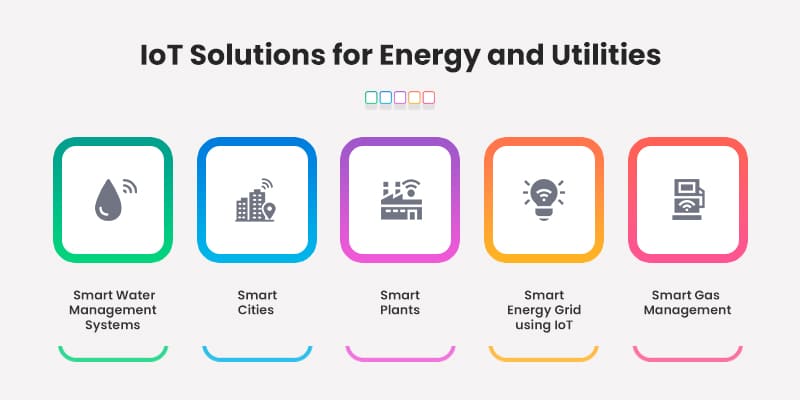
Top IoT Solutions for Energy and Utilities
Let’s look at some of the popular IoT solutions reimagining the energy and utility industry.
1. Smart Water Management Systems
Smart water management systems give an edge to the traditional alternatives, with an improved quality of life. A combination of sensors and software applications allows the utility managers to use water cautiously and ensure less wastage. These systems monitor real-time water meters, pressure, and flow to identify problem areas. These issues can include wastage, overflow, poor quality, etc. Once the problem is identified, IoT-based water management systems alert the concerned authorities to take timely corrective measures.
Key benefits of smart water management systems include:
2. Smart Cities
IBM defines a smart city as “one that optimally uses the interconnected information available to understand and control its operations and optimize the use of limited resources.”
Smart cities have been a point of focus for governments across the globe. Being at the forefront of the digital revolution, smart cities aim at using technology to improve the quality of life and drive economic growth. An example of the smart cities’ application would be smart parking system that help drivers find parking spaces or street lights capable of dimming themselves with the sunrise. Other smart sensors and monitoring systems alert the authorities about potential problems such as water leakage, accidents, etc. Let’s take a look at the working of smart city infrastructure.
The working of smart cities depends on the data and its collection. This data is collected via interconnected devices. Here are the steps that act as a backbone to the smart cities’ implementation:
- Data Collection: Smart sensors collect real-time data
- Data Analysis: The data is analyzed to turn information into actionable insights about services and operations.
- Communication: Actionable insights are sent to the decision-makers.
- Action: Right actions are decided to improve processes and manage assets.
Key benefits of smart cities include:

3. Smart Plants
IoT has started industrial revolution 4.0. This has made the manufacturing industry stronger, more profitable, and safer. Sensors installed within the plant help authorities and managers gain real-time insights into the production cycle. This data gives deep insights into efficiency, worker safety, plant security, quality of the products, inventory, and more. Everything combines to reduce the business downtime and ensure higher revenue.
Key benefits of smart plants include:
4. Smart Energy Grid using IoT
The electric grid refers to the network of transmission lines, substations, transformers, and more than transmitting electricity from powerplants to the target locations. Smart electric grids represent the digital transformation of electricity networks. It allows a two-way flow of electricity. They can collect real-time data to detect, analyze, and proactively react to changes in usage and related issues. They also have self-healing capabilities and enable consumers to participate proactively.
Smart grids are the answer to the series of power failures that can disrupt multiple operations and hence the lives of citizens. They make the power systems more resilient and improve their preparedness in emergencies like storms, solar flares, floods, etc. Smart grids allow automatic rerouting in case of a power cut or appliance failure. Anytime there is a power outage, this technology isolates the outage before it becomes large-scale.
Key benefits of smart energy grids include:
- Reduces emissions
- Lesser fuel cost
- It can be integrated with different energy sources, including renewal options
- Instant feedback on energy consumption and production
- Seamless fault detection and solution
- Efficient energy supply based on demand
Read More: IoT-Based Smart Grid System Development: Revolutionizing Energy Management
5. Smart Gas Management
Gas aids such as cylinders are susceptible to human negligence. This often causes gas leakage that can even be life-threatening and destroys buildings. Smart gas systems can avoid this, besides offering a lot of other functions. IoT-based smart gas management systems are end-to-end remote solutions that help gas distribution agencies to collect consumer records and take timely measures in case of red flags.
These solutions are installed with the gas meters and regularly monitored for malfunctions, leakage, demands, etc. The data collected from the smart gas meters is transmitted to the management for them to make critical data-driven decisions.
Read More: Discover how implementing an automated meter reading system can revolutionize your energy company’s efficiency, accuracy, and customer satisfaction.
Key Benefits of Smart Gas Management System Include:
Lead the Revolution of IoT in the Utility and Energy Market with Matellio
IoT offers a wide array of opportunities for stakeholders in the utility sector. Businesses are increasingly investing the technology to improve this sector and make it more efficient, safe and sustainable. If you are someone looking to lead a revolution with an innovative IoT development company by your side, Matellio can help.