




The web is evolving. It has witnessed the makeover and has brought many changes for developers to focus on. Now, these JavaScript developers had a real task in front of them, that is, to adopt these changes. JavaScript was initially used for client-side. But now the time has changed, it is also used as the server-side programming language. JavaScript development frameworks can save you a tremendous amount of time and effort in developing javascript-based web and mobile apps. However, these frameworks are the ones that made their debut in recent years and are now being used by the developers tremendously. Many JavaScript development companies have acknowledged these frameworks’ presence and find them as a “wow’ factor to work with. Whereas many developer communities are already dedicatedly working with these frameworks to amaze the world.
According to the statistics, JavaScript was one of the most popular programming languages used by developers in the year 2019. The position is similar in the year 2022. So, keeping this in mind, we have jotted down the best JavaScript development frameworks, but before going through them, let’s know why we need the JavaScript development frameworks.
What Are The JavaScript Frameworks And Why Do We Need One?
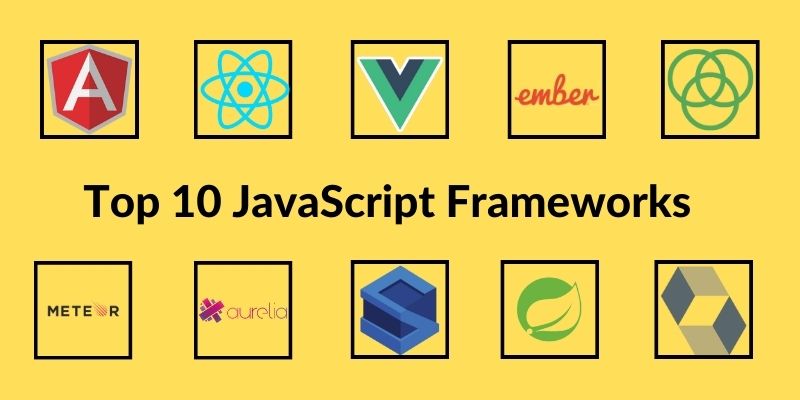
Put simply; the java framework is the tool the companies can leverage to build advanced web applications and SPA’s. JavaScript is now being used as a platform to implement backend, connect with the server, and perform different tasks and operations. Since web apps are exploded in popularity in the past few years, companies like Twitter and Airbnb won’t ask you to download specific software. Instead, they have created web interfaces that have made it easy for their users to interact with. With this, web apps from these companies, many other incorporations, and large-scale companies are up for creating a smooth user experience. Today’s modern web apps, even the small ones, need a large amount of JavaScript to build a desired client-side functionality.
In general, the JavaScript development framework creates a Model View Controller (MVC). This MVC’S concept helps in developing structured user interfaces with client-side loading functionality. Several times it happens, when we create a sophisticated user interface to be run in a web browser, it’s time-consuming, and we need to write a similar code again and again. The JavaScript frameworks help to organize JavaScript for apps that, too, without going to a cloud server. The JavaScript framework structures the web applications and eliminates the time spent on creating the new MVCs.
Every framework has different libraries and tools, best suitable for different types of web apps.
Angular.Js
Created and kept by Google, Angular.Js is one of the well-known, efficient, and powerful JavaScript development frameworks. It is an open-source front-end web framework that helps programming designers to assemble single-page web applications (SPA) intuitively like no other. The framework brings together the functionalities of HTML, Javascript, CSS. Also, based on the needs of the components in the application, HTML syntaxes can be extended. AngularJs’s data binding and dependency injection remove much of the code we otherwise have to write. Additionally, it all happens within the browser, which makes it an ideal partner with any server technology.
React.Js
Created by Facebook, ReactJS has been ruling the world of JS since the year 2018. It is an effective open-source JavaScript library used to make an intuitive UI. Website admin uses the framework to deal with the view layer of complex websites and applications. ReactJS is used to build and operate a dynamic user interface of web pages. React JS also has a concurrent mode and the suspense model that helps the developers to build more feature-rich apps. Furthermore, we can quickly develop reusable UI components with the React JS framework. The library aims to be both efficient and flexible, simple design views for each application, and efficiently update and render the right component when the data changes.
Vue.Js

A progressive JavaScript library, Vue.Js, is lightweight. The library uses the most current web technologies to develop the apps according to the users’ requirements. Additionally, it also makes use of single-file components and plain HTML-based templates. The actual CSS can be written with the help of the Vue JS framework. The framework has an in-built approachable core library that focuses on the view layer as well as consists of an ecosystem of supporting libraries, which helps in handling the complexity of the apps on a significant single page. Vue was initially designed to be incrementally adoptable. The developers can use the framework easily in the project with different JS libraries. The framework is easy to learn, as well as has simple documentation.
Ember.Js

Ember.Js is a JavaScript framework that helps in creating an ambitious web application. The framework enables its users to write dramatically less code, that too, with the templates that automatically update. Also, the framework helps to retrieve models, with productive relationships, from the server. The users don’t have to waste time on trivial choices. Ember.js abstractions enable the developers to focus on the uniqueness of the app & the framework is built for productivity.
And, its friendly APIs allow the developers to get the task done efficiently and effectively. Further, the framework’s community offers active support, which is the most significant advantage to the developers. Moreover, Ember JS provides its users with excellent, stable performance, quick load, and speed.
Mithril.Js

Mithril is a modern client-side java framework that is used to create single-page applications. The framework is small (< 10kb gzip), speedy, and offers routing and XHR utilities to its users. Further, it has quicker library load time and update execution as well as different frameworks. One of the obvious reasons that make Mithril different from other platforms is its file size, and it is not dependent on other libraries. The framework can be easily implemented whenever needed.

Meteor.js

The framework is gaining popularity and is an open-source platform for web, mobile, and desktop. It’s a full-stack, and highly opinionated MVC framework, for node.js and is also a little flexible.
Additionally, the framework allows for rapid prototyping and produces cross-platform code (Android, iOS, web). The platform can also be used with its blaze tempting engine and also with the Angular and React frameworks. As we all know, it’s a daunting task to choose the right one in the given number of frameworks. So, it is crucial to select the one that can meet all the hard and fast requirements of the app. The key to the framework is hinted right in its name i,e, speed. And Meteor is the smart choice for you in case you are looking to develop smaller, reactive web and mobile applications on the node.js platform.
Aurelia.js
The Aurelia JavaScript framework is a modern front-end JavaScript framework for creating mobile, desktop applications. Aurelia aims at aligning closely with web platform specifications, favors convention rather than configuration, and has minimal framework intrusion. The Aurelia applications are developed using a series of simple components. The framework is easy to learn, as it has a standard-based style, which makes it the only framework that empowers its users to develop components using vanilla javascript.
Furthermore, the framework provides speed and is capable of batching DOM updates, which leaves other frameworks in the dust. With this, the users can experience consistent and scalable performance, no matter how complex their UI is.
Struts
Apache Struts is a free and open-source web platform that helps us to create modern Java web applications. Just like Aurelia, it also uses convention over configuration. By separating the model from the view and controller, Apache Struts fix the problem created with a standard Java EE web application. Apache’s plugin-based architecture and plugins are very beneficial. Users can extend the framework easily, depending on the project requirement. Additionally, Strut plugins are basic JAR packages and hence, are portable.
Lastly, the framework allows its users to build maintainable, extensible, and flexible web, mobile, and desktop applications based on standard technologies, like JSP web pages, JavaBeans, resource bundles, etc.
Spring

The spring framework is a lightweight and robust framework used for application development. This framework is a well-defined tool supporting various web applications using Java as a programming language. It is lightweight in regards to size and functionality and has Aspect-Oriented Programming, which is used to separate cross-cutting concerns (like logging, security, etc.) from the business logic of the application. Also, the framework is divided into modules, which makes it easy to pick and choose parts to use in any application. Spring also designs and manages the lifecycle and configurations of the application objects. In addition to it, the framework has a dependency injection that enables its users to build loosely coupled applications. At last, the framework is integrated with other frameworks, as it doesn’t try to solve the already solved problems. It just integrates them with its development framework and provides a more exceptional solution.
Hibernate

Hibernate comes with an arsenal of helpful tools as well as capabilities that make a connection to the database much more accessible. It is an open-source rational mapping library for Java especially, designed to map objects to an RDBMS to implement the object-oriented programming concepts. Hibernate is connected with the database itself and uses HQL (hibernate query language) to execute the queries because an HQL understands object-oriented concepts, such as inheritance, association, etc. The framework resolves the object-relational impedance mismatch queries mainly due to the connection between the relational database and an application written in an object-oriented programming language style.

Final Takeaway
The above mentioned are the top 10 Java development tools or Frameworks. We all know that picking the best suitable framework for the business that can fulfill all the hard and fast requirements is not a cakewalk. With a change in time, business requirements, and client demand, a lot more frameworks are expected to rise in the market and can make their places in this rundown soon. So, all you need to do is analyze the requirements of the frameworks as per the requirement. Matellio, with more than a decade of experience, can develop ultimate applications across desktop and mobile using JavaScript development frameworks. With our flexible engagement models, you can easily keep your budget under control. Being a reliable software development company, we offer short turnaround time and flawlessly engineered solutions for the growth of your business. Get in touch with our experts over a 30-min free consultation call to discuss things in more detail.