




The banking industry stands at a crossroads. Customer expectations are skyrocketing, competition is fierce, and traditional processes are becoming a millstone around banks’ necks. Lengthy onboarding times, manual tasks galore, and compliance headaches are dragging down efficiency and frustrating customers. But there’s a powerful solution on the horizon: Digital Transformation in Banking with RPA (Robotic Process Automation).
According to Allied Market Research, the global RPA market in banking was valued at $745.4 million in 2021 and is projected to reach $7.1 billion by 2031.
RPA in banking not only streamlines processes but also reduces costs and boosts efficiency. And that’s not all! Besides cost reduction and boosted efficiency, digital transformation in banking with RPA also results in automated risk identification, data-driven decisions, automated compliance management, seamless customer onboarding, customer-focused policies and products, and more! Intrigued?
In this blog, we will explore how RPA transformation strategies are shaping the future of banking, the benefits offered by RPA, and why partnering with a digital transformation services company is crucial for success.
The Need for Digital Transformation in Banking with RPA
Digital transformation is no longer a luxury but a necessity for banks aiming to thrive in today’s fast-paced environment. Traditional banking methods are becoming obsolete, and customers demand faster, more efficient services. This has led to a surge in adopting digital solutions, with RPA playing a pivotal role.
Here’s a glimpse into the challenges of traditional banking processes that are hindering Digital Transformation in Banking:
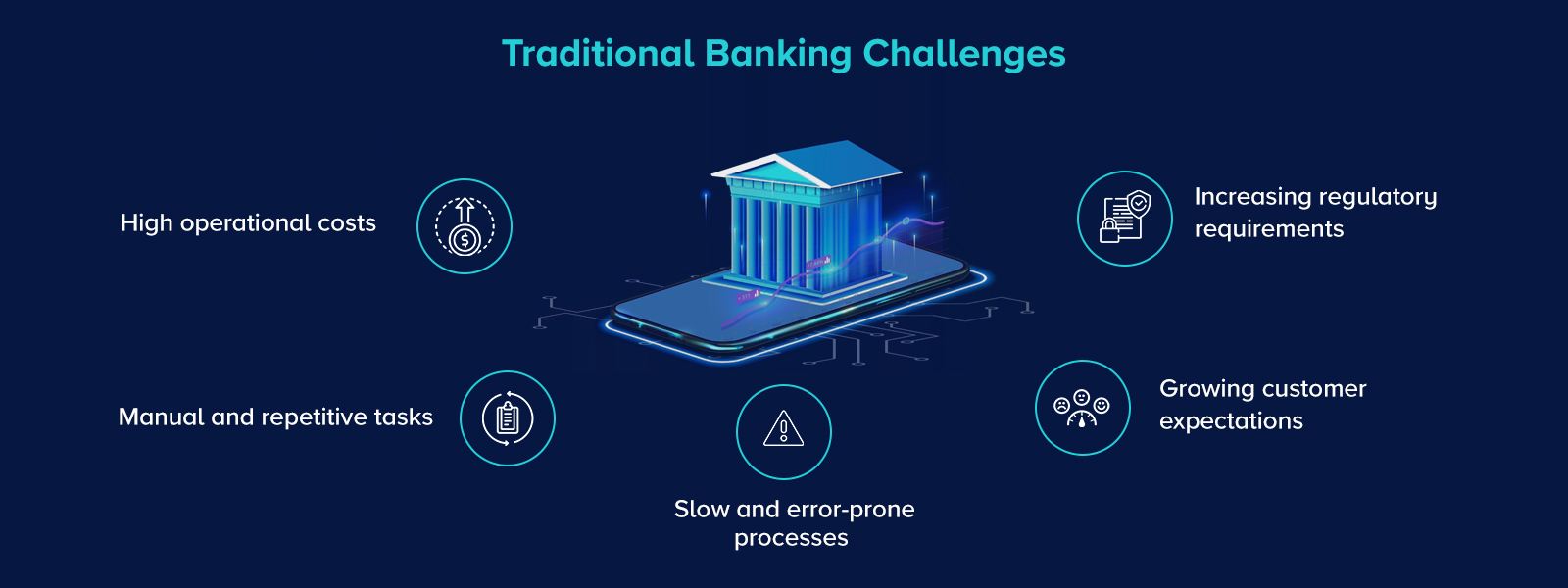
Time-Consuming KYC Onboarding
The Know Your Customer (KYC) process is often a time-consuming journey for new customers. Manual data collection from paper forms, lengthy verification procedures, and physical document management create a frustrating experience that extends onboarding times and leads to customer drop-off.
Slow and Tedious Loan Processing
The loan application process can be a slow and arduous maze. Loan officers spend hours sifting through financial documents and manually assessing creditworthiness, resulting in bottlenecks and inconsistencies in decision-making. Robotic process automation as a service can streamline this workflow by automating data extraction, validation, and decision-making, reducing manual effort and errors. Additionally, gathering data from disparate sources for loan processing becomes less cumbersome and more accurate with automation.
Labor-Intensive Fraud Detection
Monitoring transactions for fraudulent activity is a crucial but labor-intensive task. Manual review is slow and susceptible to missing red flags, potentially leading to financial losses. Implementing complex fraud detection algorithms often requires specialized skills, creating a resource constraint.
Regulatory Reporting Burden
Compiling data for regulatory reports is a time-consuming black hole. Manual data extraction and formatting from various banking systems is tedious and error-prone, potentially leading to hefty fines. Inconsistent reporting practices across departments further complicate matters.
Customer Service Inefficiencies
Traditional customer service channels often leave customers frustrated. Repetitive inquiries bog down agents, limited availability creates long wait times, and a lack of personalization hinders customer satisfaction.
These challenges translate to lost business opportunities, potential regulatory problems, and a damaged reputation. But there’s a way to break free from these limitations and embrace the future of banking: Digital Banking Automation with RPA.
Read More: Transform banking experiences with Custom Retail Banking Software for seamless transactions, enhanced security, and personalized customer engagement.
Facilitating Digital Transformation in Banking with RPA
Digital transformation in banking with RPA in financial services involves using software robots or “bots” to perform repetitive tasks that were traditionally handled by humans. These bots can execute processes quickly, accurately, and without fatigue, making them ideal for tasks such as data entry, compliance checks, and customer service.
With RPA in banking, you can achieve reduced costs, smart and efficient operations, less dependency on human resources, error-free data entry, and personalized customer interactions for your bank.
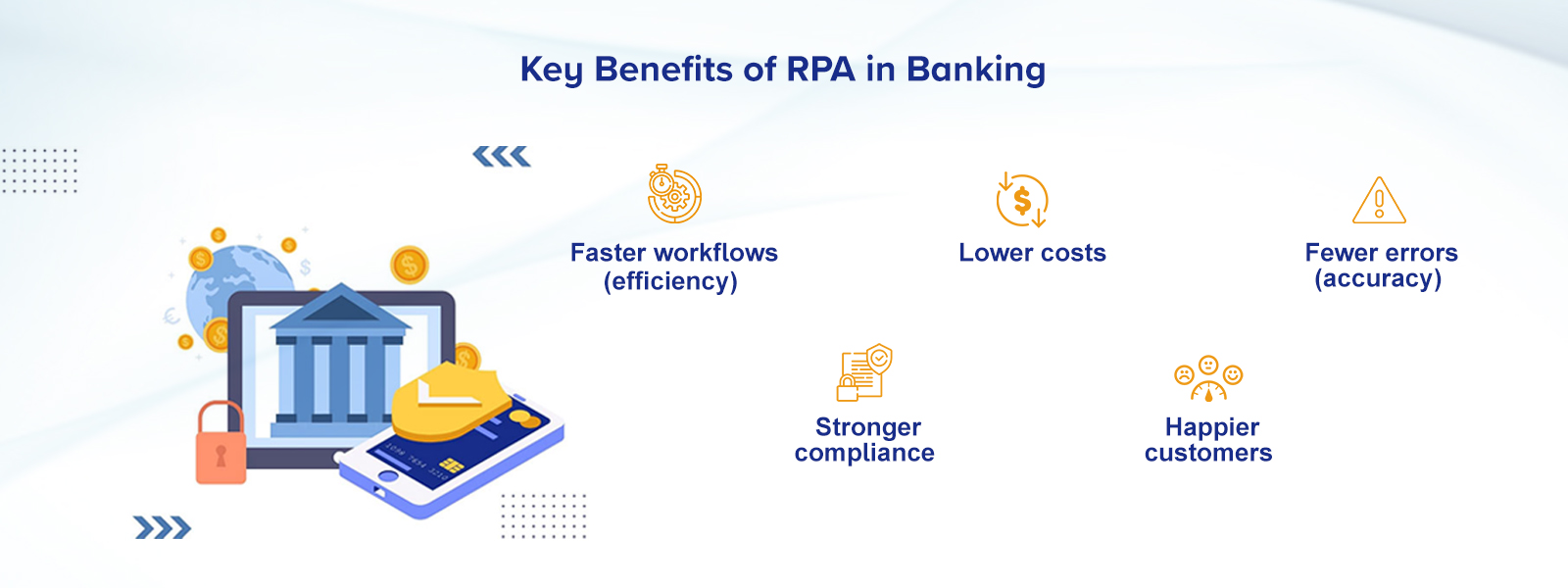
But is that all? Wait, there’s more to it. Digital transformation in banking with RPA can result in automation of several business areas, including but not limited to:
1. Customer Onboarding
Customer onboarding is a critical process in banking, often involving extensive paperwork and multiple verification steps. RPA simplifies this process by automating data collection, validation, and verification. This leads to faster onboarding, reduced errors, and a seamless customer experience.
2. Loan Processing
Loan processing involves various checks and verifications that can be time-consuming. RPA can automate these tasks, from initial data collection to final approval, significantly reducing processing times and enhancing efficiency.
Also Read- RPA for Loan Processing Automation: Revolutionizing Banking Efficiency
3. Compliance and Risk Management
Banks face stringent regulatory requirements that necessitate continuous monitoring and reporting. RPA can automate compliance checks, risk assessments, and regulatory reporting, ensuring that all requirements are met promptly and accurately.
4. Fraud Detection
RPA, combined with artificial intelligence (AI), can analyze large volumes of transaction data in real-time to detect fraudulent activities. This proactive approach enhances security and protects both the bank and its customers.
5. Effortless Data Extraction
RPA in manufacturing, equipped with Optical Character Recognition (OCR) technology, transforms scanned documents into editable text. Imagine – customer information extracted from IDs and documents in seconds, not hours! This frees up your team and dramatically improves efficiency.
6. Precision Verification
RPA goes beyond copying data. It cross-checks customer information against internal databases and external sources, ensuring accuracy and compliance with regulations. This minimizes errors and strengthens your KYC process, a crucial step in Digital Transformation in Banking with RPA.
7. Streamlined Document Management
No more paper chase! RPA banking innovations automate document collection, organization, and storage, allowing for easy access and review. This saves time, reduces physical storage needs, and improves the overall workflow.
Also Read: Unlock the power of Business Intelligence in Banking to drive data-driven decisions, optimize operations, and enhance customer experiences with actionable insights.
Ready to Integrate RPA in Banking for Future-Proof Banking Digital Transformation?
RPA Transformation Strategies – How to Get Started with Banking Automation in 6 Easy Steps?
Implementing digital transformation in banking with robotic automation in financial services, specifically using RPA, requires a strategic approach to ensure that the technology delivers maximum benefits. Here are some key strategies for a successful RPA transformation.
 Assessing Processes for Automation
The first step is to identify which processes are suitable for automation. These are typically repetitive, rule-based tasks that do not require human judgment. Conducting a thorough assessment helps prioritize processes that will deliver the most significant impact. You can also leverage business and technology consulting services to streamline this step of RPA implementation.
 Choosing the Right RPA Tools
Choosing the right RPA tools is akin to selecting the perfect tools for a superhero’s utility belt. Here are some key features to look for when selecting your RPA toolkit for banking:
- Robust Security: Look for RPA tools with robust security features like role-based access control, encryption, and audit trails. Tools like UiPath, Blue Prism, and Automation Anywhere offer strong security options.
- Scalability: Ensure the chosen RPA platform can scale seamlessly to accommodate increasing transaction volumes and user requirements. Tools like Microsoft Power Automate and Kryon RPA boast high scalability.
- Integration Capabilities: Look for tools that integrate effortlessly with your existing core banking systems, document management systems, and other critical applications. Tools like Workfusion and NICE Robotic Process Automation excel at integrations.
- Advanced Analytics: Consider RPA solutions that offer built-in analytics capabilities to monitor bot performance, identify process bottlenecks, and optimize workflows. Tools like Automation Anywhere and Blue Prism provide valuable data insights.
| Need | Tools |
| Security | UiPath, Blue Prism, Automation Anywhere |
| Scalability | Microsoft Power Automate, Kryon RPA |
| Integration Capabilities | Workfusion, NICE Robotic Process Automation |
| Advanced Analytics | Automation Anywhere, Blue Prism |
| User-friendliness | UiPath, Microsoft Power Automate |
| Cost-effectiveness | UiPath (freemium version available), Microsoft Power Automate (varies based on plan) |
| Legacy System Integration | Blue Prism, NICE Robotic Process Automation |
| Artificial Intelligence (AI) Integration | Automation Anywhere, UiPath |
While pre-built RPA solutions offer a quick start, they may not always fit the unique needs of your bank. Consider partnering with a trusted RPA development services company to explore the benefits of custom RPA solutions.
 Partnering with an RPA Development Services Provider
To ensure a streamlined and effective implementation, it is crucial for banks to partner with a specialized RPA development services provider. Working with experts in RPA can help you:
- Design customized RPA solutions that integrate seamlessly with existing systems and processes.
- Ensure robust security features to protect sensitive customer information.
- Provide ongoing support and maintenance to adapt to evolving regulatory requirements.
- Ensure that you get a wide array of digital transformation services under one roof, along with technology consulting, software development, UI/UX, testing services, cloud integration and migration, etc.
- Leverage a wide array of resources for your project with years of experience in developing custom RPA solutions for businesses like yours.
Hence, always choose a trusted RPA development services company for your project. Go with the one that also offers complimentary market analysis and competitor research services. Well, we offer such services at Matellio!
 Feature Selection & Agile Development: Building the Right Solution Together
Imagine your RPA solution as a superhero with a specific set of powers. Collaborate with your development partner to meticulously select the RPA features that best address your unique banking needs. Focus on features that deliver the highest impact on efficiency, accuracy, and compliance. Examples include:
- Screen scraping and data extraction: Automate data capture from existing bank systems and documents.
- Process automation: Automate repetitive tasks like loan application processing and account onboarding.
- Exception handling: Equip your RPA bots to handle unexpected situations and route complex cases to human agents.
- Reporting and analytics: Gain valuable insights into bot performance and identify opportunities for further optimization.
Embrace the power of the Agile methodology throughout this process. Agile development breaks down the project into smaller, iterative sprints, allowing for continuous feedback and adjustments. This ensures you achieve digital transformation in banking with RPA use cases in banking that truly meet your evolving needs and leverage the expertise of your development partner.
 MVP Development & Testing
Don’t try to build the entire RPA solution at once. Partner with your development team to create a Minimum Viable Product (MVP). This initial version focuses on core functionalities, allowing you to test, validate, and receive valuable user feedback before scaling up. This iterative approach minimizes risk and ensures you’re building the right RPA solution from the ground up.
Testing and refinement are crucial for a successful RPA implementation. Your development partner will conduct rigorous testing to ensure the accuracy, efficiency, and security of your RPA solution. This includes testing compatibility with existing systems and data security protocols and handling various user scenarios. By integrating testing and refinement within the MVP development stage, you can identify and address potential issues early on, ensuring a smooth and successful deployment.
 Cloud Deployment
Deploying your RPA solution on a secure cloud platform offers numerous advantages. Cloud integration services allow for easy scalability as your bank’s needs grow. Additionally, it provides centralized access to your RPA solution from anywhere, improving accessibility and collaboration for your team. This final step ensures your RPA solution is readily available, adaptable, and fosters a collaborative environment for continuous improvement.
By following these streamlined steps and leveraging the expertise of your RPA development services company, you can ensure a successful RPA implementation that propels your bank toward a digital future.
Are You Still in Confusion and Want Expert’s Assistance for Banking Digital Transformation with RPA?
Future of RPA in Banking
The future of RPA in banking looks promising, with several trends shaping its evolution. As banks continue to embrace digital transformation, RPA will play an increasingly vital role in driving innovation and efficiency.
Here are the key future trends you can adopt for digital transformation in banking with RPA:
Integration with AI and Machine Learning
Utilizing AI development services with RPA will enable banks to handle more complex tasks, such as predictive analytics and decision-making.
Read More: Discover how AI-driven digital transformation can revolutionize your business operations, enhance decision-making, and drive growth.
Expansion of Use Cases
RPA will extend beyond traditional processes to areas like customer service, marketing, and HR, providing comprehensive automation solutions.
Enhanced Security Measures
As cyber threats evolve, RPA solutions will incorporate advanced security features to protect sensitive data and ensure compliance.
Scalability and Flexibility
Future RPA solutions will offer greater scalability and flexibility, allowing banks to adapt quickly to changing business needs and regulatory requirements. However, partnering with a trusted RPA development services provider is crucial to reap this benefit.
Why Choose Matellio for Digital Transformation in Banking with RPA
When embarking on digital transformation in banking with RPA, selecting the right partner is crucial. Matellio stands out as a trusted provider of RPA development services, offering tailored solutions to meet the unique needs of financial institutions. Here’s why Matellio is the right choice:
 Expertise and Experience
 Our seasoned professionals have extensive experience in developing and implementing RPA solutions specifically for the banking industry. Our experts ensure smooth, compliant RPA implementations that meet regulatory requirements.
 Customized Solutions
 We offer tailored fintech software development services equipped with AI and RPA that integrate seamlessly with your existing systems and processes, ensuring maximum efficiency and minimal disruption.
 Robust Security Measures
 Matellio implements strong security measures to protect sensitive customer information and ensure regulatory compliance, including encryption, role-based access control, and audit trails.
 Scalability and Flexibility
 We develop scalable and secure RPA solutions that grow with your business, adapting to increased transaction volumes and evolving regulatory requirements. Our expertise in RPA in healthcare ensures that our solutions meet the unique demands of the healthcare industry, supporting seamless integration, data security, and compliance with industry standards.
Read More: Discover how Digital Process Automation Software Development streamlines operations and enhances efficiency in the digital-first era.
 Ongoing Support and Maintenance
 We provide continuous support and maintenance to keep your RPA processes efficient and compliant. Our team is always available to optimize your RPA solutions.
 Comprehensive Digital Transformation Services
 Matellio offers end-to-end digital transformation services, including technology consulting, software development, UI/UX design, testing, and cloud integration, ensuring a holistic approach to your transformation goals.
Contact us to get started with digital banking automation. Get a free 30-minute consultation for your project!
Conclusion
Digital transformation in banking with RPA is not just a trend; it is a necessity for financial institutions looking to enhance their efficiency, reduce costs, and improve customer experience. RPA in retail and banking offers a powerful solution for automating routine tasks, allowing both sectors to focus on strategic initiatives and stay competitive in a rapidly evolving market.
For decision-makers in the finance sector, partnering with a specialized digital transformation services company for RPA development services is a strategic move that promises significant returns. The benefits of increased efficiency, accuracy, and compliance far outweigh the initial investment, making digital banking automation an indispensable tool for the modern banking landscape.
Embrace the future of banking with RPA and transform your operations today. Stay ahead of the competition, ensure compliance, and deliver exceptional customer experiences via digital transformation in banking with RPA.
FAQ
[sp_easyaccordion id=”50655″]