

Executive Summary
Manual legal documentation and trademark processes are slowing down retail innovation. Despite growing investments in technology, many legal departments are struggling to modernize.
According to the Seventh Legal Department Operations (LDO) Index by Thomson Reuters, nearly 47% of legal teams report that the pace of technological and process advancement within their departments remains slow or stagnant. More than 20% admit their existing legal technologies, such as contract management, document management, and workflow automation, are significantly underutilized [1].
In retail, where trademark filings, supplier contracts, and compliance updates move at high speed, this lack of automation creates operational bottlenecks, compliance risks, and mounting legal overheads. Routine legal work still depends heavily on manual data entry, repetitive review cycles, and disconnected storage, making it difficult to scale with business growth.
AI in legal document management and workflow automation is refining this environment. Retail enterprises are beginning to deploy automated trademark filing systems and document digitization frameworks that drastically shorten cycle times while improving accuracy and transparency.
Matellio, an experienced digital engineering partner in legal tech, supports enterprises in modernizing legal workflows through integrated trademark lifecycle management, automated document routing, and secure legal data management.
This blog explores how retail enterprises can modernize their legal operations through automation. It discusses why automation matters, how it works, the measurable ROI, and the best practices that prepare legal teams for the future of AI-driven compliance.
I. Why Legal Workflow Automation Matters for Retail Enterprises
Retail legal departments operate in a demanding environment where contracts, vendor agreements, trademarks, and product compliance documentation must all move quickly yet remain accurate. Traditional processes still rely on paper trails and email chains, slowing execution and limiting transparency across teams.
Manual Processes Cost Up to 20% of Contract Value
Contract inefficiencies erode up to 9% of total contract value across organizations, according to Deloitte. Best-performing teams lose around 3%, while the least efficient may forfeit more than 20% [2].
On the more positive side, Sirion research [3] reveals that replacing manual markup with AI-powered redlining delivers measurable impact:
- Review cycles shortened by 45 to 90%
- Costs cut by nearly one-third
These figures demonstrate that automation in legal workflows is not just operational fine-tuning, but it directly contributes to profitability.
Every Product Launch Multiplies Your Legal Workload
For retailers, every product launch, supplier agreement, or marketing initiative introduces layers of contractual and regulatory activity. Manual processes create predictable problems:
- Amplified turnaround time
- Obscured accountability
- Inconsistent compliance reporting
Legal workflow automation in retail offers a different model: structured collaboration, real-time visibility, and the ability to handle increasing documentation volumes without inflating overheads.
In a sector driven by margins and speed, digital legal collaboration software equipped with AI-powered legal document processing turns legal operations from a bottleneck into a strategic function.
II. Keeping Pace with Retail’s Speed: The Mismatch Between Commerce and Legal Operations
Understanding IoT in Fleet Context
Retail businesses now introduce new collections, limited-edition products, and omnichannel campaigns every few weeks. Marketing and product teams operate in continuous release cycles. Legal teams, however, are often constrained by manual review methods, spreadsheet tracking, and static document repositories.
While commerce has become digital-first, many legal processes remain anchored to email-based approvals and siloed document management systems. The result is slower turnaround for contracts, missed renewal windows for trademarks, and growing compliance backlogs. This misalignment drags on time-to-market and increases operational risk.
Product Launch Velocity vs Legal Bandwidth Limits
Every new product line triggers a cascade of legal work, from vendor contracts and packaging approvals to brand clearance checks. Retailers competing on seasonal or trend-based schedules cannot afford multi-week review cycles.
Yet legacy approval workflows and a lack of integrated legal document approval workflows stretch legal bandwidth to its breaking point. What once took months now needs to happen in days, but systems cannot catch up. Without document automation legal tech, legal teams face escalating workloads that slow commercial momentum.
The Global IP Challenge and Rising Trademark Volume
WIPO (2024) reports 11.8 million global trademark filings, almost three and a half times the volume in 2009 [4]. For retailers expanding internationally, each brand or sub-brand requires coordinated filings across multiple jurisdictions, each with its own timelines and classifications.
Manual tracking creates duplication and missed renewals. Automated trademark filing systems equipped with AI document processing reduce these risks by centralizing application data and generating jurisdiction-specific reminders.
Compliance Complexity in a Connected Marketplace
Data protection, advertising standards, and product-safety laws evolve faster than traditional documentation frameworks can adapt. A retailer operating in both the EU and the US must balance GDPR, CCPA, and emerging AI-use regulations simultaneously.
Maintaining version control, audit trails, and secure legal data management across these frameworks is labor-intensive. Legal collaboration tools that integrate with ERP and CRM systems synchronize policy updates and simplify audit evidence generation. Without automation, compliance remains reactive instead of predictive.
The Resulting Operational Strain
The cumulative effect is measurable: delayed approvals, inconsistent records, and reactive risk mitigation. Retail legal teams prioritize urgent filings over strategic advisory work, limiting their ability to support innovation.
Workflow automation for legal teams, spanning AI-driven intake, automated routing, and document validation, offers the only practical path forward for retail legal operations to match the pace of modern business.
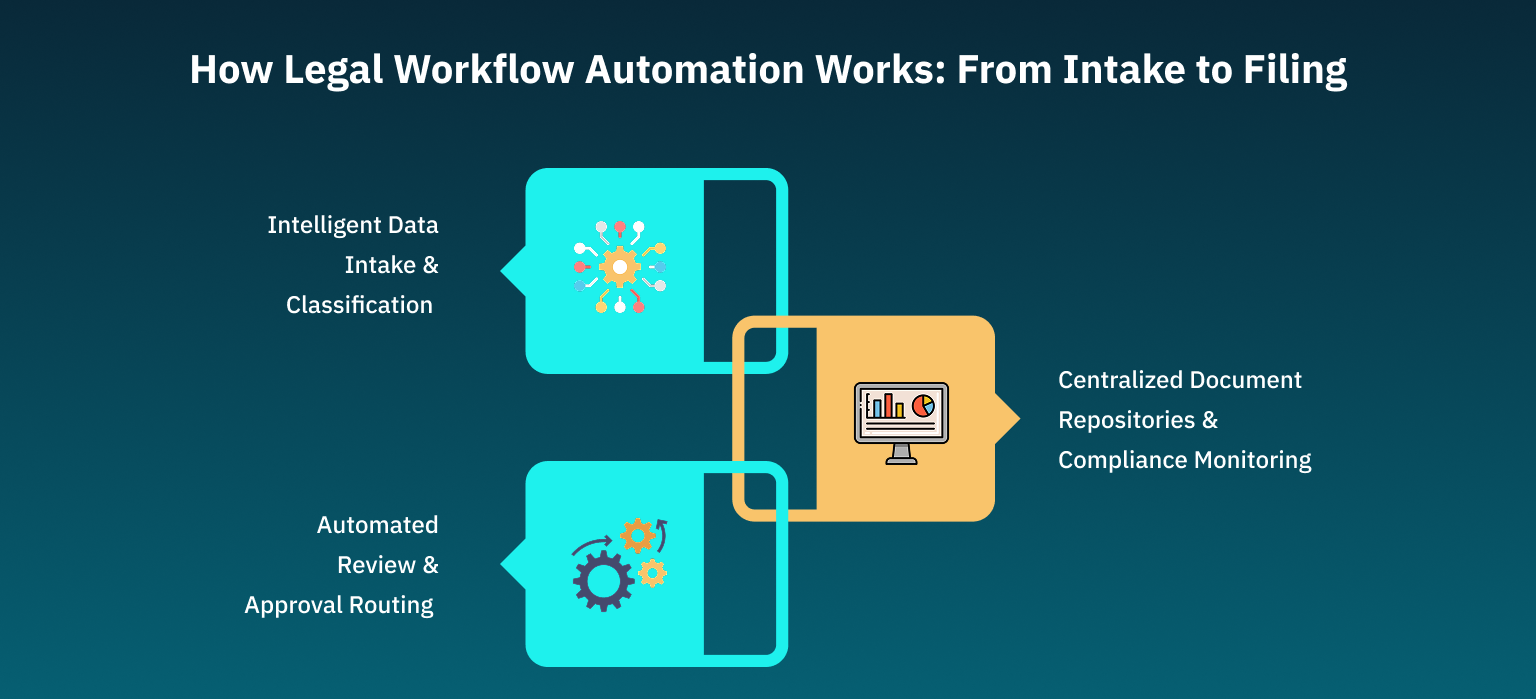
III. How Legal Workflow Automation Works: From Intake to Filing
Modern legal workflow automation transforms how retail legal teams handle documents from the moment a contract arrives to its final filing and storage. By combining AI-powered processing, intelligent routing, and centralized management, automation replaces manual handoffs with seamless digital workflows.
Here’s how each stage works:
Intelligent Data Intake and Classification
Retail legal teams manage high document volumes: supplier agreements, NDAs, invoices, and filings. Traditionally, each required manual review and categorization. AI-powered legal document processing changes this by using optical character recognition (OCR) and natural language processing (NLP) to extract key details automatically.
What the system captures:
- Party names and contact information
- Expiration dates and renewal terms
- Critical clauses and risk terms
- Payment schedules and obligations
These capabilities transform scanned or unstructured text into structured, searchable data. When integrated with trademark management software or contract lifecycle tools, this information becomes instantly available for search, validation, and downstream workflows.
Intelligent data intake not only reduces human workload but also enhances traceability, an essential step in legal document digitization.
Automated Review and Approval Routing
Manual review processes are often linear and dependent on email chains. Automation introduces digital workflows with preconfigured rules and e-signature integration for legal docs.
How automated routing works:
- Each contract follows a defined path: initial review, secondary verification, approval, and archival.
- Audit trails automatically record who reviewed what and when.
- AI-supported contract analytics flag noncompliant clauses or missing documentation before final approval.
- Approval hierarchies adapt dynamically based on jurisdiction or document type.
Retailers operating across regions benefit especially, as the system adjusts routing based on regional requirements without manual configuration.
By replacing sequential approvals with concurrent digital routing, automated legal document approval workflows accelerate turnaround time and enhance collaboration.
Centralized Document Repositories and Compliance Monitoring
Fragmented document storage increases risk and slows retrieval during audits. Cloud-based legal document management systems create a single source of truth, allowing legal and business teams to access documents securely from any location.
Key capabilities of centralized repositories:
- Automated reminders for upcoming renewals or policy expirations
- Metadata tagging for quick classification by regional regulations
- Cross-checking trademark filing status across intellectual property offices
- Encryption, access control, and real-time backups for data protection
For trademark filings, automated monitoring prevents lapses by tracking status changes across multiple jurisdictions simultaneously.
Secure legal document automation strengthens data protection in a regulatory environment where data breaches carry significant penalties, ensuring both agility and accountability.
IV. Case Study: Applying Legal Workflow Automation in Practice
The impact of automation becomes clearer when seen in practice. A leading legal filling services provider experienced how automated legal workflow can move beyond process optimization to deliver measurable accuracy, compliance, and speed.
Automated Trademark Management System for a Leading Legal Filling Services Provider
The Challenge
A leading provider of legal filing services encountered major efficiency challenges. Manual data entry, repetitive verification, and disconnected systems slowed turnaround times and increased error rates. Scaling operations under these conditions became difficult, especially while maintaining rigorous compliance and data security for sensitive trademark filings.
The team needed a solution that could automate core processes, improve data accuracy, and handle rising workload volumes without proportional increases in headcount.
The Solution
Matellio designed and deployed a comprehensive trademark management automation system and workflow orchestration principles. The solution integrated automated trademark filing capabilities, AI-driven search, and structured workflows that replaced manual verification.
Key features included:
- Automated document routing that shortened approval cycles
- Intelligent data mapping enabling API-based validation of filings
- Centralized dashboard providing real-time application tracking and analytics
This approach unified fragmented processes and introduced secure legal data management across all filing stages.
The Impact
- Faster processing time
- Filing accuracy
- Seamless compliance validation
- Scalable infrastructure supporting volume growth
- Enhanced data protection through layered security protocols
By transforming manual workflows into digital, data-driven operations, the client was able to achieve improved speed and reliability in its legal processing pipeline. This case study proves that automated legal document management delivers a measurable business advantage
V. Matellio’s Legal Automation Expertise in Enabling Scalable and Compliant Retail Workflows
Retailers often struggle to balance innovation speed with compliance rigor. Matellio’s expertise in AI legal services directly addresses this challenge, providing automation that scales with organizational complexity.
Key Capabilities:
|
Document Automation and Robotic
Process Automation (RPA) Streamlines document creation, Relevance: Reduces review time and supports consistent |
Trademark and IP Management Tools
Uses AI for classification, search, and due diligence. Relevance: Retailers managing multiple sub-brands gain unified |
|
Custom Legal AI Apps and Chatbots
Offers interactive assistance for compliance queries, Relevance: Enhances internal collaboration and supports |
Secure Legal Data Management
Implements encryption, role-based Relevance: |
Matellio’s AI-driven legaltech solutions are not theoretical concepts but proven systems designed for scale. They align directly with retail’s operational tempo, turning legal functions into agile, insight-driven business partners.
VI. Quantifying the ROI of Legal Workflow Automation
Automation investments in legal operations often face scrutiny until quantified through measurable outcomes. Retail legal departments can assess returns through three key lenses: time savings, cost reduction, and compliance improvement.
Time Savings and Productivity Gains
Contract review, trademark verification, and document validation are high-frequency, low-value tasks in most legal teams. AI-powered legal document processing shortens these cycles dramatically.
Industry analyses show that automated redlining and smart clause detection reduce review time by 50-75%, allowing legal teams to focus on strategic work such as risk forecasting and regulatory alignment.
The following benchmark data [5] quantifies the time savings across industry-wise performance metrics using AI-driven contract redlining:
| Metric | Manual Review | AI-Powered Redlining | Time Savings |
|---|---|---|---|
| Contract review speed | 4–8 hours per contract | 1–2 hours per contract | 50–75% reduction in review time |
| Risk detection accuracy | 65–80% identification rate | 85–95% identification rate | 15–25% improvement in catching critical issues |
| Draft completion timeline | 3–5 days to first draft | 4–8 hours to first draft | 80–90% faster turnaround |
| Review consistency | 60–70% consistency across team members | 95–98% consistency across team members | 30–35% improvement in standardization |
Automation also accelerates trademark lifecycle management by handling filings, renewals, and status checks in real time. Retailers managing multiple brands or SKUs gain predictable turnaround windows and faster approvals, directly supporting product launch timelines.
cost-Benefit Analysis
Legal professionals typically command $150–400 per hour. When automation reduces review and approval cycles by 60%, the resulting labor efficiency is substantial. For a retail enterprise handling 1,000 annual contracts, time savings translate to an estimated $360,000–960,000 in yearly labor cost reduction [6].
Beyond direct labor savings, automation also minimizes opportunity costs tied to contract delays. Faster turnaround shortens vendor onboarding and revenue recognition cycles, which allows teams to redeploy legal bandwidth toward higher-value strategic negotiations or compliance strategy. Over time, this reallocation boosts ROI by increasing throughput and accelerating deal velocity. These benefits compound as contract volumes scale.
Compliance and Risk Mitigation value
Beyond labor metrics, automation contributes to risk management, a value often overlooked. Centralized repositories and audit-ready workflows eliminate data fragmentation and make compliance evidence retrieval almost instantaneous. Retailers benefit from real-time compliance dashboards that track document expirations, approvals, and access logs.
AI-powered solutions also cut post-signature disputes by 60%, directly reducing both contract-related conflicts and compliance violations [7]. This dramatic decline in disputes reflects improved clarity, consistency, and risk detection throughout the contract lifecycle.
The net outcome is a legal function that operates as both a compliance guardian and a business accelerator. ROI, therefore, extends beyond cost savings to include brand integrity, faster market entry, and reduced legal exposure.
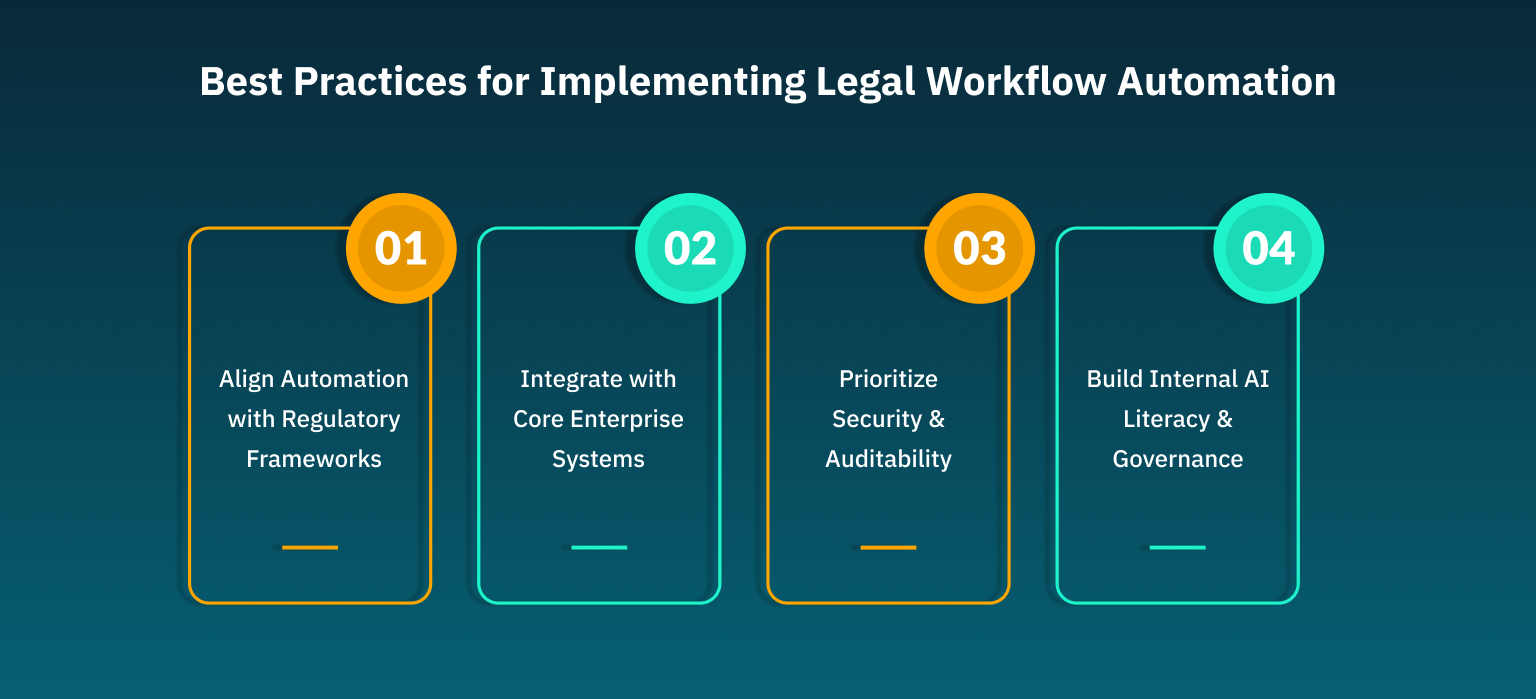
VII. Best Practices for Implementing Legal Workflow Automation
While the potential of automation is clear, realizing its full value requires disciplined implementation.
Gartner’s 2024 research cautions that by 2027, 60% of organizations will fail to realize expected AI value due to rigid data governance frameworks with little or no alignment with business context [8]. Building legal data governance early prevents misalignment and creates accountability.
These best practices help retail legal teams deploy solutions that scale responsibly and deliver sustainable returns:
1. Align Automation with Regulatory Frameworks
Automation should operate within the context of applicable laws such as GDPR, CCPA, and intellectual property regulations. Systems must be designed with compliance checkpoints embedded in each workflow: automated consent tracking, jurisdiction-based storage policies, and traceable document histories.
Retailers should evaluate vendors based on their ability to adapt automation rules to changing global compliance standards.
2. Integrate with Core Enterprise Systems
Legal teams should avoid standalone tools. Integration with ERP, CRM, and product lifecycle systems ensures a seamless exchange of data between legal and business functions.
For example, automated trademark filing workflows can trigger directly from new product entries in ERP, maintaining synchronization between product launches and legal documentation.
3. Prioritize Security and Auditability
As legal documents often contain confidential IP and supplier data, automation must include encryption, multi-factor authentication, and role-based access. Secure legal document automation platforms provide full visibility into document history, such as who accessed, reviewed, or modified each file, creating defensible audit trails.
4. Build Internal AI Literacy and Governance
Automation maturity depends on internal understanding. Legal teams should develop AI governance structures to evaluate accuracy, bias, and performance metrics of automated systems.
Read More: Implementing Automation in Retail: A Complete Guide
VIII. The Future of Legal Tech in Retail: From Automation to Intelligence
The next phase of digital transformation in retail legal operations will move from automation to intelligence, where AI not only executes tasks but also predicts and prevents compliance issues.
Predictive Compliance and Risk Forecasting
Emerging AI systems will analyze historical filings, dispute patterns, and contract terms to forecast risk exposure before it materializes. Predictive alerts will warn legal teams of jurisdictions with upcoming regulatory shifts or highlight contract clauses that historically trigger disputes.
In retail trademark management, machine learning will recommend filing strategies by analyzing competitor activity, opposition trends, and renewal cycles. This will turn reactive filing into proactive brand protection.
Connected Legal Ecosystems
Future-ready legal collaboration software will integrate tightly with broader enterprise systems. Legal teams will operate alongside product, finance, and supply chain functions through unified dashboards powered by AI document processing and real-time analytics. This will make way for continuous intelligence where legal data informs faster strategic decisions.
Automation forms the operational base, and intelligence forms the strategic future. By investing today in well-structured legal workflow automation, retail enterprises position themselves for tomorrow’s predictive, insight-driven compliance era.

Key Takeaways
- Legal workflow automation in retail addresses critical inefficiencies in contract review, trademark filing, and compliance management.
- Automation reduces cycle times, improves data accuracy, and delivers tangible ROI through labor savings and dispute reduction.
- Case evidence from Trademark Engine shows how document automation legal tech can scale operations without compromising security.
- Success depends on governance, integration, and security that complement regulatory frameworks.
- The future of legal operations lies in predictive intelligence that converts compliance from reactive oversight into strategic foresight.
FAQ’s
Automation eliminates repetitive verification and search tasks through AI-powered trademark management software. Retail legal teams minimize manual filing errors, which directly cuts labor costs and reduces expensive rework.
Teams should adopt rule-based routing, integrate e-signature capabilities, and implement automated compliance validation within unified platforms. These practices streamline approvals and maintain audit-ready documentation throughout the workflow.
AI systems detect inconsistencies, missing fields, and outdated terms during document processing. This approach achieves sub-1 percent filing error rates compared to traditional manual review methods.
Secure legal data management requires encryption, restricted user roles, and continuous monitoring. These measures create a traceable, compliant digital record for every legal transaction.
Unified dashboards and version-controlled workflows make contract and filing statuses visible to all stakeholders. This transparency enhances accountability and accelerates decision-making across departments.
References
[1] Thomson Reuters, Legal Departments Continue to Face an Increased Workload, Budgetary Pressures, and Slow Technology Adoption According to Research from Thomson Reuters Institute
[2] Deloitte, Boosting ROI across the contract management lifecycle
[3], [5], [6], [7] Sirion, Measuring Time Savings: AI Playbook-Driven Redlining vs. Manual Review in 2025
[4] WIPO, World Intellectual Property Indicators 2024
[8] Gartner, Adopt a Data Governance Approach That En

