
Executive Summary
Artificial intelligence has evolved from a futuristic concept to a fundamental pillar of modern financial services. Today’s financial institutions face mounting pressure to deliver faster, more personalized services while maintaining security and compliance. AI solutions in finance address these challenges by automating routine tasks, uncovering insights from vast data sets, and enabling real–time decision–making at scale. This guide explores how AI in FinTech is reshaping the industry, from fraud detection, customer service, to AI–powered credit scoring and compliance management. More importantly, it examines the tangible business value that AI delivers, including reduced operational costs, accelerated processes, enhanced customer experiences, and improved return on investment. For organizations navigating digital transformation, understanding AI’s practical applications and implementation considerations has become essential for remaining competitive. You will also discover how Matellio is leading this transformation with its custom AI solutions development for FinTech.
Introduction: The Transformation of Financial Services
Financial services have always been fundamentally about managing information, evaluating risk, detecting patterns, understanding customer needs, and making informed decisions quickly. For decades, these processes relied heavily on manual reviews and rigid rule-based systems that struggled to adapt to changing conditions.
Machine learning in FinTech changes this paradigm entirely. Instead of following pre-programmed rules, AI agents for financial services learn from data, recognize complex patterns, and continuously improve their performance. They process thousands of transactions per second, spot subtle anomalies humans would miss, understand natural language queries through conversational AI in finance, and predict future behavior based on historical patterns.
This isn’t about replacing human expertise with machines. AI financial advisors and intelligent systems augment human capabilities by handling repetitive, data-intensive tasks, freeing financial professionals to focus on relationship building, complex problem-solving, and strategic decisions requiring empathy and nuanced judgment.
The global AI in FinTech market was valued at $44.08 billion in 2024 and is projected to reach $83.10 billion by 2030 [1]. This growth reflects widespread recognition that AI has become an essential infrastructure for modern financial services.
Understanding AI Technologies in Financial Services
Before exploring specific applications, it’s important to understand what AI actually means in financial contexts. The term encompasses several key technologies working together to create intelligent systems.
- Machine Learning for Financial Services forms the foundation. These algorithms analyze historical data to identify patterns and make predictions about future outcomes. A machine learning model might study millions of loan applications to understand which characteristics predict successful repayment, then apply that learning to evaluate new applications with remarkable accuracy.
- Natural Language Processing Financial Analysis enables computers to understand and generate human language. This powers AI chatbots for banking that hold natural conversations, analyze sentiment in customer feedback, extract information from documents, and interpret regulatory language thus creating a hyper-personalized financial experience for each customer.
- Deep Learning uses neural networks inspired by the human brain to recognize complex patterns. These systems excel at fraud detection AI models, document verification, and market prediction by processing vast amounts of data simultaneously.
- Predictive Analytics in Finance applies these technologies to forecast trends, behaviors, and outcomes, from customer churn and loan defaults to market movements and operational bottlenecks, enabling real-time risk alerts fintech systems that protect both institutions and customers.
- Generative AI in FinTech is particularly powerful due to its ability to continuously learn and improve. Traditional software follows fixed rules that quickly become outdated. AI systems adapt as new data becomes available, automatically refining their models to reflect changing conditions. This is a crucial capability in an industry where changes happen constantly.
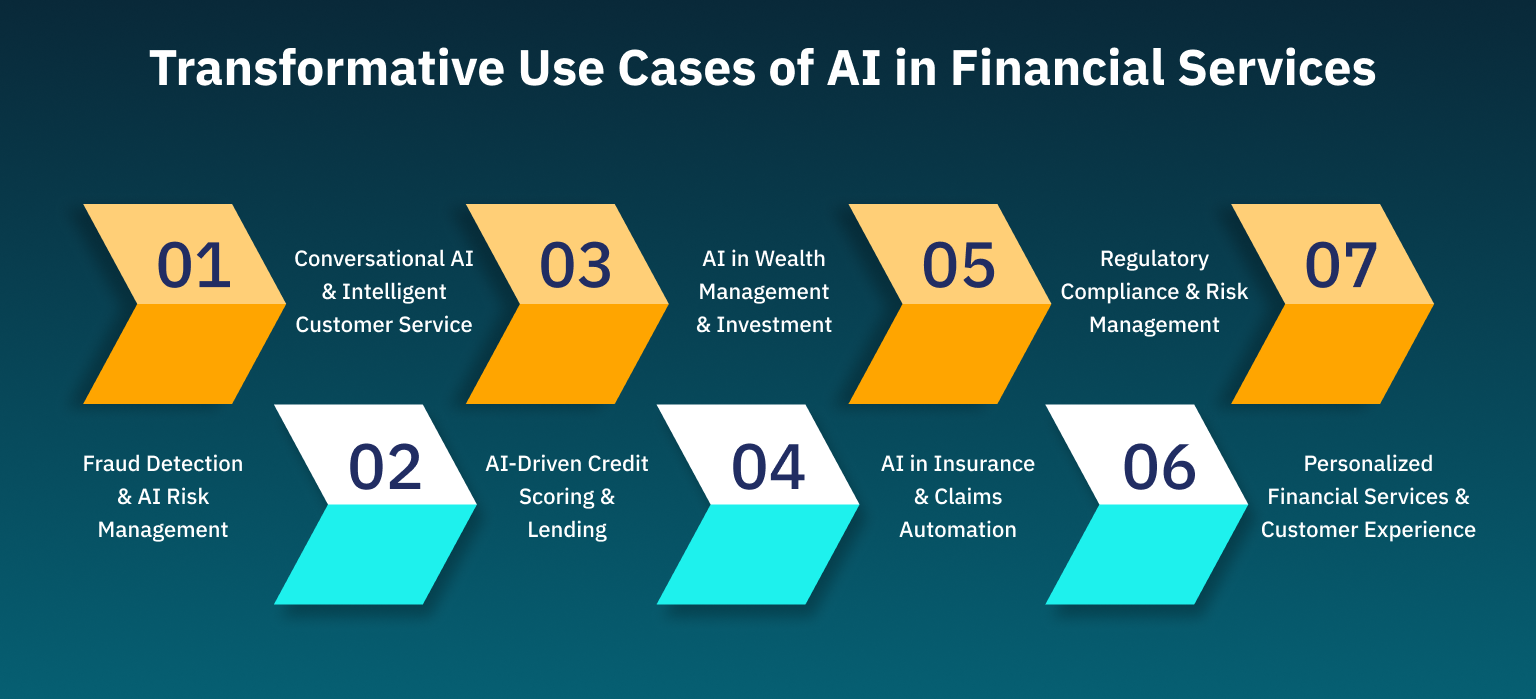
Transformative Use Cases of AI in Financial Service
1. Fraud Detection and AI Risk Management
Financial fraud has evolved dramatically. Criminals now employ sophisticated techniques which involve false identities, account takeovers, complex money laundering schemes that traditional systems struggle to detect. Fraud detection with AI helps to analyze transaction patterns in real-time, considering hundreds of variables simultaneously to assess risk through advanced AI risk management capabilities.
The key advantage is contextual understanding. Rather than applying simple rules like “flag transactions over $10,000,” fraud detection AI models consider whether purchases align with normal behavior, match known fraud schemes, or show subtle indicators of account compromise. These systems continuously learn from new fraud attempts, automatically updating detection models.
The U.S. Treasury’s implementation of machine learning for fraud detection prevented and recovered over $4 billion in fraudulent payments in fiscal year 2024, up from $652.7 million the previous year [2]. This demonstrates AI’s tangible impact on loss prevention. Currently, 73% of financial organizations use AI for fraud detection [3], while 42.5% of fraud attempts now involve some form of AI themselves [4], making intelligent defense mechanisms essential.
2. Conversational AI and Intelligent Customer Service
Customer expectations have changed fundamentally. People want instant answers, 24/7 availability, and hyper-personalized financial services delivered through their preferred channels. AI chatbots for banking bridge this gap by handling routine inquiries instantly, checking balances, explaining fees, initiating transfers, all without human intervention.
Modern conversational AI for banks uses natural language processing to understand intent even when customers phrase questions differently. They maintain context throughout conversations, handle follow-ups naturally, and recognize when situations require human intervention, seamlessly transferring with full conversation history.
Bank of America’s Erica virtual assistant has facilitated over 1.5 billion customer interactions with more than 37 million clients [5]. The global generative AI chatbot market size was valued at USD 7.66 billion in 2024 and is projected to grow from USD 9.90 billion in 2025 to USD 65.94 billion by 2032, exhibiting a CAGR of 31.1% during the forecast period [6]. Financial institutions implementing chatbots report that customer service expenses can be reduced by up to 30%, with queries resolved in under 2 minutes compared to 11 minutes previously [7].
The business impact extends beyond cost savings. By resolving simple queries instantly, conversational AI in finance improves satisfaction while freeing human agents to focus on complex issues requiring personal attention like fraud investigations, loan applications, or sensitive financial counseling.
3.AI-Driven Credit Scoring and Lending
Traditional credit scoring creates a vicious cycle: people can’t get credit because they lack credit history but can’t build history without access to credit. Millions find themselves excluded from financial services due to this structural limitation.
AI-driven credit scoring breaks this cycle by incorporating alternative data sources like utility payments, rent history, employment stability, education, transaction patterns, thus painting a more complete picture of financial responsibility. This doesn’t lower lending standards; it improves them by analyzing a broader range of relevant data through sophisticated machine learning for financial services.
Studies show AI-powered credit scoring reduces loan rejections by 70% for traditionally underserved borrowers while maintaining or improving default prediction accuracy [8]. Companies like Upstart, by incorporating factors like education and employment history, have reduced defaults by 75% while expanding access [9].
Digital footprint signals can predict loan defaults as accurately as traditional credit scores, with combined approaches improving accuracy further [10]. The global RegTech market, applying AI to regulatory compliance, was valued at $15.8 billion in 2024 and is projected to reach $70.8 billion by 2033 [11], reflecting the technology’s expanding role.
4.AI in Wealth Management and Investment
AI in wealth management has democratized sophisticated investment services previously available only to high-net-worth individuals. AI-powered financial advisors and robo-advisors use predictive analytics fintech to analyze client goals, risk tolerance, and market conditions, automatically building and managing diversified portfolios.
Algorithmic trading AI processes market data at speeds impossible for human traders, identifying profitable opportunities and executing transactions in milliseconds. These AI agents for automated trading simultaneously monitor thousands of securities across multiple markets, analyzing price movements, news feeds, social media sentiment, and economic indicators.
AI-driven investment strategies don’t just react to market movements; they predict them. By analyzing historical patterns, current trends, and real-time data, these systems make more informed trading decisions across broader datasets. Autonomous AI trading systems continuously adjust strategies based on changing market conditions, optimizing returns while managing risk.
This shift toward AI in wealth management enables institutions to serve more clients efficiently while maintaining high-quality, personalized investment management that adapts to each individual’s unique financial situation.
5. AI in Insurance and Claims Automation
AI is reshaping insurance across underwriting, pricing, and claims. Instead of relying on static rules and broad risk buckets, insurers now feed models with richer signals like telematics data, IoT sensor readings, detailed business profiles, and behavioral patterns over time. That lets them price risk more accurately, spot anomalies earlier, and reserve underwriter time for complex edge cases while routine decisions are handled automatically in the background.
On the claims side, AI speeds up the process without sacrificing control. Document intelligence can read and classify claim forms and reports, computer vision can assess damage from photos, and decision models can triage, approve simple claims, or flag suspicious ones for review. McKinsey estimates that applying AI across insurance could generate up to $1.1 trillion in additional annual value by 2030, much of it coming from smarter underwriting and claims [14]. This isn’t just cost-cutting; it means faster, fairer payouts for customers and more sustainable loss ratios for insurers.
6.Regulatory Compliance and Risk Management
Financial regulations grow more complex yearly. Institutions must comply with anti-money laundering rules, know-your-customer requirements, data privacy laws, and industry-specific guidelines often span multiple jurisdictions. AI risk management solutions offer comprehensive approaches by automatically monitoring transactions, flagging suspicious activities, generating required reports, and interpreting new regulatory guidance.
Natural language processing financial analysis enables AI systems to read regulatory documents, identify relevant requirements, and translate them into operational compliance rules. This dramatically reduces the time required to implement new regulations. More importantly, AI solutions in finance improve compliance quality by analyzing 100% of transactions rather than statistical samples; catching violations that manual reviews would miss.
Real-time risk alerts fintech systems provide immediate notification of potential compliance issues, enabling proactive remediation before violations occur. This combination of comprehensive monitoring and instant alerting significantly reduces regulatory risk.
7.Personalized Financial Services and Customer Experience
Customers increasingly expect personalized experiences, relevant recommendations, tailored communications, and services matching their specific circumstances. Hyper-personalized financial services powered by AI make this achievable at scale by analyzing transaction histories, spending patterns, life events, and financial goals to generate individual recommendations.
Someone saving for a home receives different guidance than someone planning retirement. A frequent traveler gets different credit card offers than someone who shops locally. This hyper-personalized financial experience extends beyond marketing as AI identifies customers facing financial stress and proactively offers assistance, recognizes life events, and suggests relevant products.
The global market for AI-powered customer service is projected to grow from $6.95 billion in 2024 to $44.49 billion in 2033 . Financial institutions implementing AI solutions in finance for personalization report conversion rate improvements up to 15% and sales increases averaging 10% .
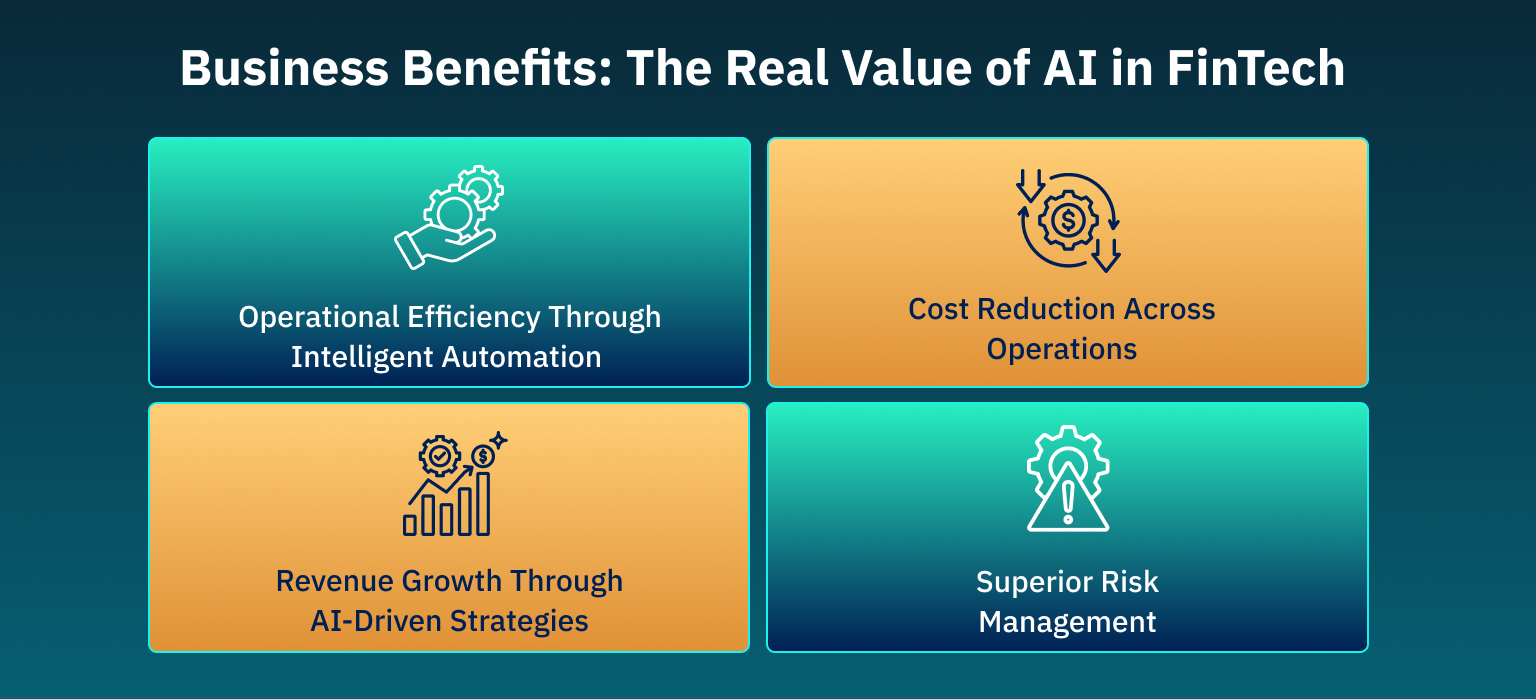
Business Benefits: The Real Value of AI in FinTech
1.Operational Efficiency Through Intelligent Automation
AI agents for financial services deliver compounding operational efficiency improvements. When AI handles 90% of routine customer inquiries , representatives focus on complex issues requiring human judgment. This improves service quality as customers with difficult problems get immediate attention rather than waiting behind simple balance inquiries.
When machine learning in FinTech processes loan applications in minutes rather than days, entire lending operations become more efficient. Faster decisions mean better customer experiences, reduced costs per application, and ability to handle higher volumes without proportional staff increases.
2.Cost Reduction Across Operations
Cost benefits from AI solutions in finance manifest across multiple dimensions. Direct labor savings from automation represent the most obvious benefit, but indirect savings often prove more significant. Fraud detection AI systems that stop fraudulent transactions save not just direct losses but also investigation costs, chargeback fees, and customer remediation expenses.
Financial institutions implementing AI comprehensively report that chatbots will enable them to cut operational expenses by 22% by 2030 , with projected cumulative savings of $11 billion between 2025-2028 [12]. These aren’t hypothetical projections; they’re based on actual results from organizations operating AI systems at scale.
3.Revenue Growth Through AI-Driven Strategies
While cost reduction gets attention, AI-driven investment strategies and personalized services often deliver more significant revenue impact. Better credit decisions expand addressable markets, approving creditworthy borrowers that traditional models would reject while reducing defaults through accurate AI-powered credit scoring.
Predictive analytics in fintech enables personalized marketing that dramatically improves conversion rates. Instead of generic offers interesting 2% of recipients, AI-driven personalization delivers relevant offers resonating with 10-15% or more. Improved customer experiences reduce churn and increase lifetime value. In competitive markets where acquisition costs run high, retention improvements deliver substantial value.
4. Superior Risk Management
Every defaulted loan, completed fraudulent transaction, and compliance violation directly impacts profitability. AI risk management systems predict and prevent such events, providing enormous value. Better AI-driven credit scoring means fewer bad loans. Real-time fraud detection AI prevents losses before they occur. Proactive compliance monitoring prevents regulatory fines and reputational damage.
Implementation Challenges and Considerations
1. Data Quality and Infrastructure
Machine learning for financial services depends entirely on data quality. Poor quality data, such as incomplete records, inconsistent formats, and outdated information, produces unreliable models leading to poor decisions. Organizations often discover that 60–70% of AI implementation effort involves data preparation rather than model development.
2. Algorithmic Bias in AI Financial Systems
AI-driven credit scoring models learning from historical data may perpetuate biases if that data reflects discriminatory practices. Studies show minority borrowers were charged higher interest rates (+8%) and rejected more often (+14%) than privileged groups [13]. Addressing bias requires diverse training data, fairness testing, and explainable AI techniques revealing which factors influenced decisions.
3. Regulatory Compliance for AI Systems
Financial regulators increasingly scrutinize AI solutions in finance, requiring institutions to explain how algorithms make decisions and demonstrate non-discrimination. This creates challenges for complex models like deep neural networks. Solutions include building explainability into systems using techniques like SHAP and LIME or adopting “white box” models sacrificing some accuracy for transparency
4. System Integration Challenges
Most financial institutions operate on legacy infrastructure not designed for AI agents for financial services integration. Connecting modern conversational AI in finance with core banking systems, payment processors, and CRM platforms presents significant technical challenges requiring careful API design and robust data synchronization.
5.Organizational Change Management
Implementing AI in FinTech isn’t just technology; it’s an organizational transformation affecting how people work and what skills they need. Effective change management requires clear communication about AI’s purpose, transparency about job impacts, comprehensive training programs, and strong leadership commitment.
Maximizing ROI with Strategic AI Implementation
Success with AI solutions in finance requires starting with clear business objectives rather than technology-first thinking. Identify specific problems like high service costs, increasing fraud losses, and poor credit decisions, then evaluate whether machine learning in FinTech offers the best solution.
Choose high-impact use cases first where AI financial advisors, fraud detection AI, or conversational AI for banks can deliver significant benefits relatively quickly. Look for applications with clear ROI potential, straightforward implementation, strong stakeholder support, and measurable success criteria. Early wins build momentum and organizational confidence.
Build the right team combining data scientists, engineers, business analysts, and change managers. Consider hybrid approaches like hiring core AI talent while partnering with experienced providers for development support. This accelerates the deployment of AI-powered credit scoring, algorithmic trading AI, and other complex systems while building internal capabilities.
Invest in robust infrastructure, computational resources, data storage, monitoring tools, and integration platforms supporting real-time risk alerts fintech, and other mission-critical applications. Establish clear performance metrics from the start and use insights to drive continuous improvement of AI-driven investment strategies and operational systems.
Organizations extracting maximum value from generative AI in FinTech treat it as ongoing programs of continuous improvement rather than one-time projects, continuously refining predictive analytics fintech models and expanding hyper-personalized financial services capabilities.
Partner with Matellio for AI Solutions Development
Navigating AI implementation complexities in financial services requires both technical expertise and deep industry knowledge. Matellio specializes in developing custom AI solutions in finance addressing unique challenges financial institutions face—from fraud detection with AI and conversational AI for banks to AI-powered credit scoring, AI risk management, and AI in wealth management.
Our approach combines strategic consulting to identify high-value opportunities for machine learning in FinTech, custom development of AI agents for financial services tailored to your requirements and regulatory environment, seamless integration of conversational AI in finance with existing systems, and ongoing support ensuring your predictive analytics fintech and AI-driven investment strategies continue delivering value as your business evolves.
Whether you need AI chatbots for banking, algorithmic trading with AI, AI financial advisors, fraud detection AI models, or comprehensive hyper-personalized financial services, we deliver solutions that drive measurable business outcomes.

Conclusion: The Future of AI in Financial Services
AI in FinTech has transitioned from experimental technology to a strategic imperative. Organizations mastering the implementation of AI agents and AI solutions for FinTech gain significant competitive advantages; operating more efficiently, serving customers more effectively, managing risks successfully, and growing more rapidly than competitors.
However, success requires more than deploying machine learning in FinTech. It demands strategic thinking about which problems AI solutions in finance should solve, attention to data quality and fairness in AI-driven credit scoring, robust governance ensuring compliance, and organizational change management preparing people for AI-augmented workflows.
The question isn’t whether to implement AI solutions – it’s how to do so thoughtfully, responsibly, and effectively. Organizations approaching AI in FinTech, investing in proper capabilities for predictive analytics in fintech, and committing to continuous learning will thrive in the AI-powered future of financial services.
As technology and customer expectations continue to evolve, institutions building strong foundations with AI solutions for finance will position themselves to leverage tomorrow’s innovations, creating sustainable competitive advantages in an increasingly automated financial landscape.
Key Takeaways
- AI in FinTech represents a fundamental shift from rule-based systems to adaptive technologies that learn and improve over time
- High-impact applications include fraud detection AI, conversational AI for banks, AI-powered credit scoring, AI risk management, and hyper-personalized financial services
- AI solutions in finance deliver value through cost reduction, revenue growth via AI-driven investment strategies, risk prevention, and scalable operations
- Implementation requires addressing data quality, algorithmic bias in machine learning for financial services, regulatory compliance, system integration, and organizational change
- Success comes from starting with business objectives, choosing high-impact use cases like AI chatbots for banking or predictive analytics fintech, building capable teams, and continuous optimization
- The global AI in FinTech market is projected to reach $83.10 billion by 2030, reflecting technology’s strategic importance
- Organizations must balance innovation with responsibility in deploying AI financial advisors and AI agents for automated trading
- Conversational AI in finance enables 22% operational expense reduction and $11 billion cumulative savings for banks through 2028
- Fraud detection AI models prevented over $4 billion in losses for U.S. Treasury in a single fiscal year
- AI-driven credit scoring using alternative data reduces loan rejections by 70% while maintaining accuracy
- AI in wealth management democratizes sophisticated investment services through AI-powered financial advisors and robo-advisors
- Real-time risk alerts fintech systems provide immediate notification of potential issues, enabling proactive risk management
FAQ’s
Modern conversational AI for banks combines natural language understanding through natural language processing financial analysis, contextual awareness, and graceful escalation to human agents when needed. AI chatbots for banking handle routine questions with clear answers while quickly transferring complex issues to humans with complete conversation history. This hybrid approach provides instant help for simple needs and faster human access for complex problems, creating a hyper-personalized financial experience that improves satisfaction across all customer interactions while enabling hyper-personalized financial services at scale.
LLMs help in investing and risk assessment by quickly reading and summarizing huge volumes of unstructured data such as news, earnings calls, filings, and social media to surface signals that would take humans weeks to find. They can turn this into concise risk and investment briefs, highlight emerging trends, support stress tests and scenario analysis, and translate a client’s goals expressed in plain language into tailored portfolio ideas, giving analysts and advisors faster, more informed starting points for their decisions.
Companies run into several hurdles when integrating AI in FinTech. Poor data quality and fragmented legacy systems make it hard to train reliable models and often require expensive cleanup and infrastructure upgrades. Algorithmic bias and “black box” behavior create compliance and reputational risks, since regulators expect transparent, explainable decisions. On top of that, there is a shortage of people who understand both AI and finance, employees often resist new workflows, and the upfront costs can be high with unclear timelines for ROI, which makes executive buy in harder.
AI improves credit scoring by using richer data than traditional models, such as utility and rent payments, employment patterns, education, and spending behavior. This helps lenders assess people with little or no formal credit history while still predicting default risk accurately.
For fraud detection, AI monitors transactions in real time, learns what “normal” looks like for each customer, and flags subtle anomalies as patterns change. LLMs add another layer by analyzing unstructured data such as emails, chat logs, and support tickets to detect social engineering, phishing, and other fraud signals that would not appear in numeric transaction data alone.
AI powered financial advisors anticipate needs by continuously analyzing spending patterns, transactions, portfolios, and life events, then matching them with market, rate, and tax changes to surface timely recommendations. Using natural language processing on client communications, they also detect signals like job changes, marriage, or upcoming retirement and proactively suggest relevant products or advice before the client asks.
AI in finance raises several ethical concerns. Algorithmic bias can bake in discrimination if models learn from unfair historical data, which affects lending, credit scoring, and pricing for minorities, women, and other protected groups. Lack of transparency makes it hard to explain why a loan was denied or a transaction was flagged, creating accountability and fairness issues, while the use of highly personal data for profiling and hyper targeted pricing raises serious privacy and exploitation risks. There is also the risk of large scale job displacement and systemic failures if many institutions rely on similar models that make the same mistakes at the same time.
AI chatbots enhance support in financial apps by giving customers instant, 24/7 help for routine tasks like checking balances, reviewing transactions, or resetting passwords, all through natural, conversational queries. They keep context across messages, can hand complex issues to human agents with full history, and use real time account data to flag unusual activity or suggest relevant products and savings tips.
References:
[1] https://www.mordorintelligence.com/industry-reports/ai-in-fintech-market
[2] https://home.treasury.gov/news/press-releases/jy2650
[3] https://www.biocatch.com/ai-fraud-financial-crime-survey
[4] https://truthscan.com/blog/ai-driven-fraud-in-financial-services-recent-trends-and-solutions/
[5] https://www.virtasant.com/ai-today/ai-roi-customer-support
[6] https://www.fortunebusinessinsights.com/generative-ai-chatbot-market-113448
[7] https://springsapps.com/knowledge/the-2024-guide-to-chatbots-in-banking
[8] https://riskseal.io/blog/future-trends-in-alternative-credit-scoring-for-fintech
[9] https://smartdev.com/how-ai-is-revolutionizing-credit-scoring/
[10] https://riskseal.io/blog/future-trends-in-alternative-credit-scoring-for-fintech
[11] https://www.imarcgroup.com/ai-in-fintech-market
[12] https://coinlaw.io/banking-chatbot-adoption-statistics/