
Executive Summary
Fleet managers face a critical paradox: more data than ever before, yet less clarity about what actually matters. The convergence of Artificial Intelligence and the Internet of Things resolves this challenge by transforming overwhelming sensor streams into actionable business intelligence. This technological revolution has a measurable impact. Predictive maintenance reduces costs by 10-40% according to McKinsey [1], real-time tracking and route optimization cut operating costs by up to 15% [2], and driver behavior monitoring significantly decreases accident rates by 20-30% [3]. With the global IoT fleet management market projected to surge from $7.03 billion in 2023 to $20.61 billion by 2030 [4], organizations that master AIoT integration gain decisive competitive advantages. This analysis explores how AI and IoT work together to scale operations, enhance safety, and optimize every aspect of fleet performance while providing practical implementation guidance for organizations beginning their digital transformation journey.
Introduction
A single delivery truck breaking down at the wrong moment can cascade into missed deadlines, frustrated customers, emergency repair costs, and lost revenue. Multiply this scenario across hundreds or thousands of vehicles, and the operational chaos becomes existential. Traditional fleet management with its fixed maintenance schedules, reactive problem-solving, and limited visibility struggles to prevent these disruptions.
The fundamental challenge isn’t lack of information. Modern vehicles generate hundreds of diagnostic codes daily. Telematics devices capture location data every few seconds. Fuel sensors, tire pressure monitors, temperature gauges, and dozens of other IoT devices create continuous data streams. The real challenge is extracting actionable insights from this overwhelming volume of information before problems escalate into expensive failures.
This is where the convergence of AI and IoT creates transformative value. IoT sensors provide the eyes and ears, continuously monitoring every critical parameter across the fleet. AI algorithms provide the brain, analyzing patterns, predicting failures, optimizing routes, and enabling proactive decision-making that would be impossible through manual processes. Together, they shift fleet management from reactive crisis response to predictive optimization.
The business impact is substantial. Predictive maintenance prevents up to 75% of unplanned breakdowns while reducing maintenance costs by 10-40% . Intelligent route optimization cuts operating costs by up to 15% . Real-time driver behavior monitoring decreases accidents by 20-30% and lowers insurance premiums . Automated compliance tracking eliminates administrative burden and regulatory risk.
Beyond operational improvements, AI and IoT address strategic imperatives reshaping the industry. E-commerce growth demands faster, more reliable deliveries. Driver shortages require maximizing productivity from existing teams. Sustainability mandates necessitate fuel efficiency and emissions reduction. Electric vehicle adoption introduces new challenges around battery management and charging infrastructure coordination.
For fleet operators navigating these pressures, AI and IoT capabilities have transitioned from competitive advantages to operational necessities. The question is no longer whether to adopt these technologies, but how to implement them strategically to drive measurable business outcomes.
The Technology Foundation: How AI and IoT Work Together in Fleet Management
Understanding IoT in Fleet Context
IoT in fleet management creates a connected ecosystem where vehicles, devices, and infrastructure continuously exchange data. Rather than isolated systems collecting information separately, modern IoT architecture integrates multiple components into unified intelligence networks.
Telematics devices serve as the primary data collection points, capturing vehicle location through GPS, engine diagnostics via OBD-II interfaces, and operational metrics including fuel consumption, speed, and mileage. These devices transmit information through 4G, 5G, or satellite networks to centralized management platforms, providing the foundational data layer that powers all subsequent analysis.
Specialized IoT sensors monitor parameters beyond basic telematics. Engine temperature sensors detect overheating risks before damage occurs, tire pressure monitoring systems prevent blowouts, fuel level sensors identify theft or inefficiency, and cargo sensors track temperature and humidity for sensitive goods. Research shows that 52% of organizations cite safety and security as their primary motivation for deploying these technologies [5].
Edge computing devices process critical data locally at the vehicle level, enabling immediate response to safety alerts without relying on cloud connectivity. This architecture becomes essential for time-sensitive applications where milliseconds matter: collision avoidance systems, driver fatigue detection, or autonomous vehicle functions.
Cloud platforms aggregate data from all fleet assets, providing centralized storage, processing power for complex analytics, and scalable infrastructure that grows seamlessly with fleet expansion.
AI’s Role in Making Sense of Fleet Data
Raw data alone solves nothing. The challenge in 2025 isn’t collecting information but extracting actionable insights from overwhelming volumes. A single vehicle can generate hundreds of diagnostic codes daily, creating what industry experts call “data overload” that paralyzes rather than empowers decision-making [6].
AI algorithms transform this complexity into clarity through sophisticated pattern recognition and predictive modeling:
Machine learning models analyze historical patterns to forecast component failures days or weeks before breakdowns occur. By examining engine temperature trends, vibration patterns, oil conditions, and driving behaviors simultaneously, these systems identify subtle combinations of factors that human analysts would miss.
Computer vision technology processes dashcam and interior camera feeds in real time, monitoring driver behavior with precision impossible through manual observation.
Deep learning algorithms continuously improve accuracy by learning from new data. As fleets accumulate operational history, AI models become more precise in their predictions and recommendations, adapting to specific vehicle characteristics, driver behaviors, and operating environments unique to each organization.
The AIoT Advantage: Real-Time Intelligence at Scale
The transformative power emerges when AI and IoT operate as an integrated system. This combination enables dynamic optimization that adapts to changing conditions moment by moment. Route planning systems analyze current traffic patterns, weather conditions, vehicle capacity, delivery windows, and driver hours-of-service to recommend optimal paths that adjust in real time. Fuel management systems identify inefficient behaviors like excessive idling and suggest coaching interventions. Safety systems detect driver fatigue and recommend mandatory rest breaks before alertness deteriorates to dangerous levels.
The shift from reactive to predictive operations represents a fundamental transformation in fleet management philosophy. Rather than responding to problems after they occur, organizations anticipate issues and intervene proactively, preventing breakdowns, avoiding delays, and optimizing performance continuously based on real-time intelligence.
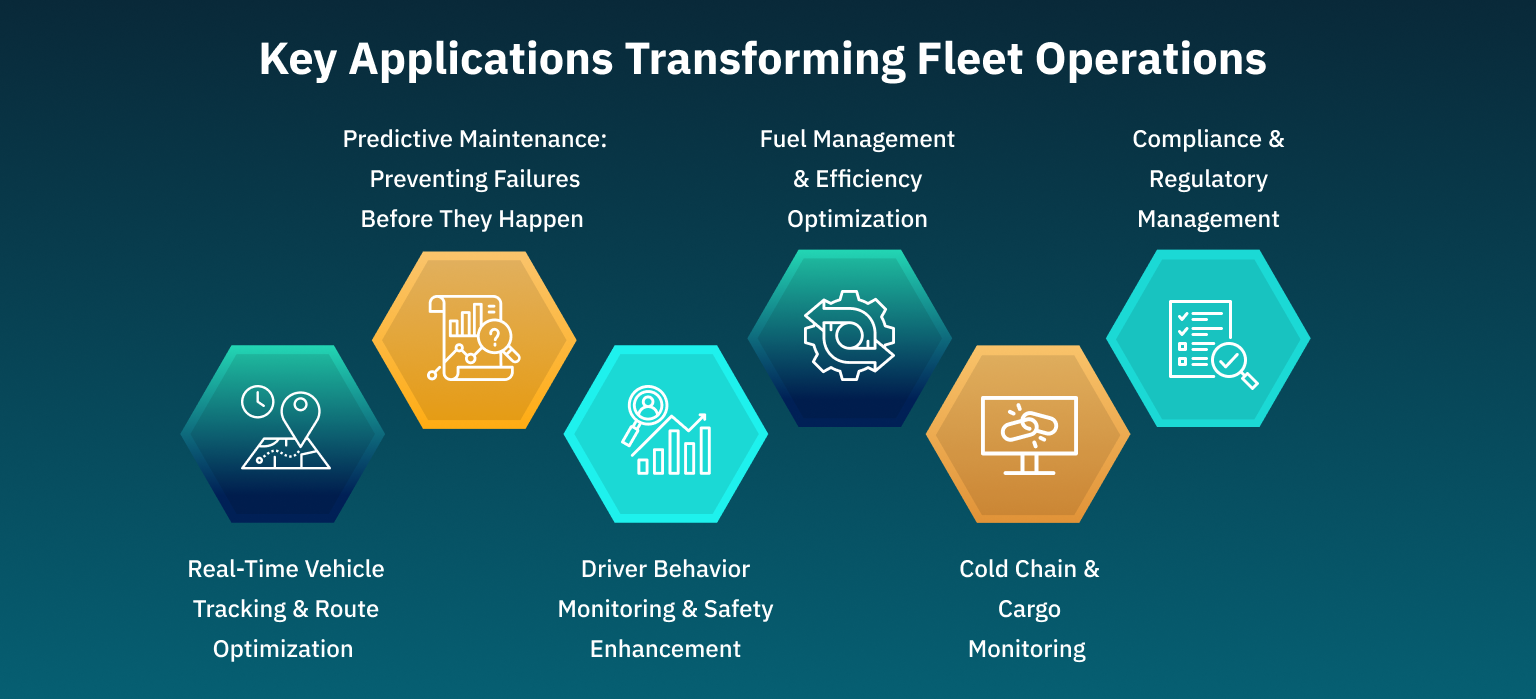
Key Applications Transforming Fleet Operations
Real-Time Vehicle Tracking and Route Optimization
Modern GPS-enabled tracking transcends simple location dots on a map. Advanced systems integrate multiple data streams to enable intelligent logistics management that adapts continuously. AI-powered route optimization calculates the most efficient paths while factoring in variables that change throughout the day. When accidents block major routes or construction creates unexpected delays, the system automatically reroutes vehicles to minimize impact. This dynamic responsiveness enables fleet operators to achieve significant reductions in operating costs.
Geofencing capabilities create virtual boundaries that trigger automated actions. When vehicles enter customer locations, the system automatically confirms deliveries and updates inventory. When vehicles exit designated operating areas, security alerts notify managers immediately. This level of automation streamlines operations while building the foundation for more advanced maintenance and safety applications.
Predictive Maintenance: Preventing Failures Before They Happen
Traditional maintenance follows fixed schedules: service every 5,000 miles or three months, regardless of actual vehicle condition. This approach either wastes resources on unnecessary maintenance or misses emerging problems that develop between scheduled intervals.
AI-powered predictive maintenance transforms this paradigm by scheduling service based on actual vehicle health. IoT sensors continuously monitor critical components: engine performance metrics, transmission temperature, brake pad thickness, battery health, and fluid levels. Machine learning analyzes these data streams alongside historical failure patterns to predict when specific components will likely fail.
One major logistics provider prevented more than 90,000 breakdowns in a single year using this approach [7]. The system identified vehicles at risk of battery failures, engine issues, or component wear, enabling proactive service that avoided disruptions during peak delivery periods. The operational impact extends beyond avoided breakdowns: reduced towing expenses, lower emergency repair costs, improved customer service from reliable deliveries, and extended vehicle lifespans through optimal maintenance timing. However, even the most sophisticated maintenance system requires human oversight to maximize its value.
Driver Behavior Monitoring and Safety Enhancement
Driver-related incidents remain a leading cause of fleet accidents and insurance claims. IoT-enabled telematics systems track driving behaviors including speeding events, harsh braking, rapid acceleration, and cornering forces. Combined with computer vision technology monitoring cab interiors for phone usage or signs of drowsiness, these systems create comprehensive safety programs.
The critical advantage is real-time intervention capability. When unsafe behaviors are detected, the system provides immediate audio alerts to drivers, enabling correction before incidents occur. Fleet managers receive notifications for follow-up coaching conversations focused on specific improvement areas revealed through data analysis.
This approach also supports positive reinforcement. AI algorithms identify top-performing drivers based on safety metrics, fuel efficiency, and customer service ratings. Beyond safety, driver behavior directly influences fuel consumption and operational costs.
Fuel Management and Efficiency Optimization
Fuel typically represents 25-35% of total fleet operating costs [8], making fuel management a critical priority. IoT sensors provide granular visibility into consumption patterns, tank levels, and refueling events across all vehicles.
AI algorithms analyze this data to identify specific inefficiencies: vehicles idling excessively at customer locations, routes that consistently consume more fuel than alternatives, drivers with aggressive acceleration patterns, and potential fuel theft indicated by unexplained tank level drops. Fleet managers receive actionable recommendations addressing each issue.
Advanced systems integrate additional variables including vehicle weight, cargo load, terrain elevation changes, and traffic conditions into fuel consumption predictions. While fuel efficiency impacts the bottom line directly, specialized cargo requirements introduce additional monitoring complexities.
Cold Chain and Cargo Monitoring
Temperature-sensitive goods including pharmaceuticals, food products, and chemicals require precise environmental controls throughout transportation. IoT sensors continuously monitor cargo hold temperature, humidity, and door open/close events, creating comprehensive records that prove regulatory compliance.
AI systems analyze these data streams to predict potential violations before they occur. When sensors detect temperature deviations from safe ranges, automated alerts notify drivers and logistics coordinators immediately, enabling quick corrective action through refrigeration adjustments or emergency rerouting.
For businesses handling high-value pharmaceuticals or perishable foods, these capabilities directly protect revenue and brand reputation while ensuring regulatory compliance with temperature documentation requirements. Managing these diverse monitoring requirements alongside regulatory obligations creates additional operational complexity.
Compliance and Regulatory Management
Fleet operations face complex regulatory requirements: hours-of-service rules, vehicle inspection schedules, emissions standards, and electronic logging mandates. Manual compliance management is labor-intensive and vulnerable to human error that results in citations and fines.
IoT-enabled Electronic Logging Devices automatically record driving hours, rest periods, and duty status changes. This data transmits to compliance management platforms that track adherence to regulations and flag potential violations before they occur. The combined power of these applications becomes clear when examining real-world implementations.
Real-World Success: Case Studies in AI and IoT Fleet Management
Inseego: Scaling Fleet Tracking to 10,000 Vehicles
Inseego, a global leader in 5G and IoT-driven fleet tracking and telematics solutions with over 30 years of expertise, faced critical challenges as they worked to scale their platform to meet enterprise client demands. Their existing system struggled with delayed reporting, inconsistent real-time updates, and slow data processing that directly impacted customer satisfaction.
The Challenge
Before partnering with Matellio, Inseego encountered several operational bottlenecks:
- Inaccurate real-time data led to delayed decisions and reduced operational efficiency
- The platform couldn’t scale to handle large fleet demands, with performance degradation during peak usage
- Manual compliance tracking created inefficiencies and increased human error
- System performance metrics including API response time and data refresh rates fell below acceptable standards
The Solution
Matellio implemented a comprehensive technology transformation leveraging Vue.js, Microsoft .NET, Azure SQL Database, PostgreSQL, and Azure Cloud infrastructure. The solution centered on several key innovations:
Real-time tracking integration using SignalR technology enabled instant communication between vehicles and the platform. A pub-sub architecture managed continuous data flow efficiently, providing fleet managers with up-to-the-second vehicle location and status information.
Advanced automation streamlined compliance workflows through backend rules and automated Cron Jobs that continuously monitored for violations, sent real-time alerts, and generated comprehensive reports without manual intervention.
Scalable cloud infrastructure on Azure created a foundation capable of supporting 10,000 vehicles simultaneously while maintaining optimal performance. The team optimized database queries, enhanced code efficiency, and implemented performance monitoring using Azure’s native tools.
Multi-tenant architecture supported multiple fleets with location-specific settings, enabling geographic expansion and accommodating diverse client requirements.
Data processing pipelines collected information from IoT-based vehicle devices, transformed it into JSON format, and inserted it into databases. The UI fetched this data using SignalR and APIs to display comprehensive fleet information in real-time.
The Results:
The partnership delivered measurable outcomes across key performance indicators:
- Enhanced real-time tracking: Location accuracy and update consistency improved significantly, reducing decision delays
- Scalable platform: The system now handles 10,000 vehicles simultaneously, enabling Inseego to serve large enterprise clients
- Automated workflows: Compliance tracking automation reduced manual workload and errors while accelerating decision-making
- Reduced overhead: Backend query optimization and cloud infrastructure improvements decreased processing overhead even during peak usage
- Improved customer satisfaction: Enhanced data accuracy, faster reporting, and reliable real-time updates strengthened client relationships
Tracking Genie: GPS-Powered Vehicle Tracking Automation
Tracking Genie aimed to develop a comprehensive GPS tracking system providing real-time location updates, security alerts, and vehicle control features for fleet operators. They faced the challenge of creating a solution that balanced sophisticated functionality with user-friendly interfaces.
The Challenge
Several complex requirements defined the project scope:
- Ensuring seamless GPS tracking across diverse operating environments
- Developing security alert systems for theft prevention and unauthorized usage
- Creating remote management capabilities for vehicle control
- Implementing geofencing features to prevent unauthorized movement
- Providing trip history tracking and vehicle diagnostics
- Building intuitive web and mobile interfaces for fleet operators
The Solution
Matellio developed a GPS-powered vehicle tracking platform integrating multiple technology layers:
Hardware-software integration connected tracking devices installed in vehicles to cloud-based data processing systems. This foundation enabled the platform to receive and manage data from numerous tracking devices operating in the field.
Real-time tracking using GPS technology provided continuous location updates for all monitored vehicles. Fleet managers gained immediate visibility into vehicle positions, movement patterns, and operational status.
Security features included automated alerts for multiple scenarios: SOS alarms for emergency situations, low battery warnings, exterior battery cut-off detection, over-speed notifications, and geo-fence breach alerts. These automated responses enabled rapid intervention when security concerns arose.
Remote control capabilities allowed fleet managers to remotely shut down vehicles, lock doors, and toggle air conditioning systems. This functionality proved essential for theft prevention and unauthorized usage scenarios.
Fleet monitoring systems tracked refrigeration temperature levels, oil levels, and vehicle controller metrics. This comprehensive monitoring helped fleet operators maintain vehicle health and prevent equipment failures.
Multi-platform access through native iOS and Android mobile applications complemented web-based dashboards. This ensured fleet managers could access critical information and respond to alerts regardless of location or device.
The Impact
The implementation delivered substantial operational improvements:
- Instant visibility: Real-time tracking improved fleet visibility and enabled data-driven decision-making
- Enhanced security: Geofencing alerts and automated security features reduced theft risks significantly
- Remote management: Vehicle control capabilities increased operational control and response speed
- Predictive insights: Maintenance monitoring provided early warning signals that improved vehicle uptime
- Cost optimization: Comprehensive fleet monitoring reduced operational costs through efficiency gains
- Scalable infrastructure: The platform architecture supported fleet expansion without performance degradation
Implementation Challenges and Practical Solutions
While the benefits of AI and IoT integration are substantial, successful implementation requires addressing several common challenges that organizations encounter during deployment.
Integration with Legacy Systems
Many fleet operators have invested heavily in existing fleet management software, maintenance tracking systems, and business applications. Integrating new IoT and AI capabilities with these legacy systems presents technical challenges.
The Challenge: Legacy systems often lack APIs for data exchange, use outdated protocols, or run on incompatible technology stacks. Organizations fear disrupting critical operations during transitions.
Practical Solutions: Start with middleware integration layers that translate data between old and new systems. Implement phased migration strategies where new capabilities run parallel to existing systems before full replacement. Use cloud-based platforms that offer flexible integration options through standard APIs, reducing custom development requirements.
Data Security and Privacy Concerns
Real-time fleet tracking involves collecting sensitive information: vehicle locations, driver behaviors, cargo contents, and customer delivery details. This data must be protected from cyber threats while respecting privacy regulations.
The Challenge: IoT devices create numerous potential entry points for security breaches. Data transmitted between vehicles and cloud platforms can be intercepted if not properly encrypted. Privacy concerns arise when monitoring driver behaviors.
Practical Solutions: Implement end-to-end encryption for all data transmission. Use secure authentication protocols for device registration and access control. Deploy regular security updates and patch management for IoT devices. Establish clear privacy policies that explain what data is collected, how it’s used, and who has access. Provide drivers with transparency into monitoring practices and focus on safety improvements rather than punitive measures.
Initial Investment and ROI Concerns
Comprehensive AI and IoT implementations require upfront investments in hardware, software, cloud infrastructure, and training. Organizations need confidence they’ll achieve positive returns.
The Challenge: Initial costs can be substantial, especially for large fleets requiring thousands of devices. ROI timelines may extend 18-36 months, creating budget approval challenges.
Practical Solutions: Begin with pilot programs that demonstrate value on a smaller scale before full deployment. Focus initial implementations on use cases with clear, measurable benefits such as predictive maintenance or fuel optimization. Calculate total cost of ownership including avoided breakdown costs, reduced fuel consumption, lower insurance premiums from improved safety, and extended vehicle lifespans. Many technology providers offer subscription pricing models that spread costs over time and align expenses with realized benefits.
Data Overload and Analysis Paralysis
IoT sensors generate massive data volumes—hundreds of diagnostic codes per vehicle per day. Without proper tools, this becomes overwhelming rather than enlightening.
The Challenge: Fleet managers struggle to identify which data points deserve attention. Too many alerts lead to “alarm fatigue” where critical notifications get ignored among false positives.
Practical Solutions: Implement AI-powered alert filtering that prioritizes notifications based on severity and business impact. Create role-based dashboards showing only relevant information for different user types. Use predictive analytics to reduce false positives by identifying actual failure patterns rather than simply flagging threshold violations. Invest in user training so teams understand how to interpret data and take appropriate actions.
Connectivity Issues in Remote Areas
Fleet vehicles often operate in rural locations with limited cellular coverage or areas where satellite connectivity is the only option.
The Challenge: Real-time tracking and alerts depend on continuous connectivity. Service gaps create blind spots in fleet visibility.
Practical Solutions: Use edge computing to process critical data locally on vehicles, with batch uploads when connectivity resumes. Implement hybrid connectivity strategies combining cellular, satellite, and local storage. Design systems that gracefully handle connection interruptions and automatically synchronize when back online. For critical operations, consider dedicated satellite communication systems despite higher costs.
How Matellio Can Help Transform Your Fleet Operations
Matellio specializes in building custom AI and IoT solutions tailored to address real-world fleet management challenges. Our approach combines technical excellence with business understanding to deliver systems that drive measurable operational improvements. We don’t offer pre-built software. Instead, we develop solutions designed specifically for your unique operational requirements, fleet size, and business objectives.
Custom Fleet Management Solutions
We build transportation and logistics software from the ground up, designed around your specific workflows and requirements. Whether you need fleet tracking automation, freight management systems, or supply chain optimization platforms, our development team creates solutions that integrate seamlessly with your existing infrastructure.
Our custom fleet management development encompasses:
- Real-time GPS tracking with geofencing capabilities and route optimization tailored to your routes
- Predictive maintenance systems built around your vehicle types and maintenance patterns
- Driver behavior monitoring with AI-powered safety coaching specific to your operations
- Automated compliance management designed for your regulatory requirements
- Asset tracking providing visibility across your specific vehicle types, equipment, and inventory
- Fuel management optimization identifying inefficiencies unique to your fleet
AI Solutions Development
Our AI solutions development services focus on building intelligent automation and predictive analytics customized for your fleet operations. We implement machine learning models that continuously improve by learning from your operational data, not generic datasets.
AI capabilities we deliver include:
- Predictive analytics for maintenance forecasting and failure prevention
- Computer vision systems for driver monitoring and cargo inspection
- Natural language processing enabling conversational fleet management interfaces
- Recommendation systems suggesting optimal routes, schedules, and resource allocation
- Anomaly detection identifying security threats, theft, or unusual operational patterns
IoT Development and Integration
Through our IoT development services, we create connected fleet ecosystems that bridge the gap between vehicles, devices, and management platforms. Our IoT expertise spans sensor integration, telematics development, and edge computing implementation.
Our IoT capabilities include:
- Custom telematics solutions capturing comprehensive vehicle diagnostics and performance data
- Sensor network design for temperature monitoring, cargo tracking, and vehicle health assessment
- Edge computing implementation enabling local data processing for real-time response
- Cloud platform integration with AWS IoT, Azure IoT, or Google Cloud IoT
- Hardware-software integration connecting diverse devices into unified management systems
End-to-End Implementation Support
Technology transformation requires more than code. We provide complete support throughout your project.
Our services include:
- Strategy consulting to identify high-value use cases and create implementation roadmaps
- Proof of concept development to validate approaches before full deployment
- System integration connecting new solutions with your existing software and infrastructure
- Quality assurance testing under real-world conditions including peak loads and connectivity issues
- Deployment and training ensuring your team can effectively use new systems
- Ongoing support with maintenance, enhancements, and optimization as your needs evolve
Proven Track Record
Our work with Inseego and Tracking Genie demonstrates our ability to deliver scalable, reliable fleet management solutions. We’ve helped clients achieve significant operational improvements: reducing maintenance costs through predictive analytics, improving safety through driver behavior monitoring, optimizing fuel consumption through route intelligence, and enhancing customer satisfaction through reliable tracking and on-time delivery.
Whether you’re managing a small regional fleet or a large enterprise operation spanning multiple geographies, Matellio has the technical expertise and industry knowledge to help you harness AI and IoT technologies for competitive advantage
Conclusion
The integration of AI and IoT is fundamentally reshaping fleet management and logistics operations. Organizations that embrace these technologies gain significant competitive advantages through reduced costs, improved safety, enhanced customer service, and data-driven decision-making capabilities.
But technology alone doesn’t guarantee success. The most effective implementations combine sophisticated technical capabilities with clear business objectives, thoughtful change management, and commitment to continuous improvement. Organizations must invest in training, establish data governance practices, and foster cultures that embrace data-driven decision-making.
Looking forward, emerging technologies including 5G connectivity, edge AI, autonomous vehicles, and electric fleet management will further expand what’s possible. Organizations that build strong foundations in AI and IoT today will be best positioned to leverage these future innovations.
The question is no longer whether to adopt AI and IoT for fleet management, but how quickly you can implement these capabilities to maintain competitiveness in an increasingly technology-driven industry.
Key Takeaways
- Market momentum is accelerating: Grand View Research projects the IoT fleet management market will grow from $7.03 billion in 2023 to $20.61 billion by 2030, reflecting rapid adoption across the industry.
- Predictive maintenance delivers substantial savings: According to McKinsey, AI-powered systems reduce unplanned downtime by up to 75% and lower maintenance costs by 10-40% through early failure detection and optimized service scheduling.
- Real-time visibility enables better decisions: IoT-enabled GPS tracking with AI-powered route optimization reduces operating costs by up to 15% and improves on-time delivery performance.
- Driver safety improvements are measurable: Computer vision and telematics-based behavior monitoring significantly reduces accidents by 20-30% through real-time coaching and intervention.
- Integration is achievable: Despite legacy system challenges, practical implementation strategies including middleware solutions and phased migrations enable successful AI and IoT adoption without disrupting operations.
- ROI timelines are reasonable: While upfront investments are required, most organizations achieve positive returns within 18-36 months through avoided breakdowns, fuel savings, reduced insurance costs, and extended vehicle lifespans.
- Security must be prioritized: End-to-end encryption, secure authentication, and comprehensive privacy policies protect sensitive fleet data while addressing legitimate security concerns.
- Success requires strategy: The most effective implementations combine technology with clear business objectives, user training, and cultures that embrace data-driven decision-making.
FAQ’s
IoT devices provide continuous location data, traffic conditions, and vehicle status. AI algorithms analyze these streams alongside historical patterns, delivery windows, and driver availability to calculate optimal routes. The system automatically reroutes vehicles around congestion or accidents. This approach enables accurate customer ETAs, maximizes delivery capacity, minimizes empty miles, and balances workloads while respecting hours-of-service regulations.
Modern predictive maintenance uses machine learning to analyze IoT sensor data including engine temperature patterns, vibration signatures, oil quality, battery cycles, and historical failures to predict component failures before they occur. Deep learning identifies subtle anomalies such as unusual vibration patterns indicating bearing wear. Digital twin technology creates virtual vehicle replicas that simulate how operating conditions affect component wear. Edge AI processes critical diagnostics locally on vehicles for real-time predictions without cloud connectivity.
AI combines data from multiple IoT sources. Telematics track speed, acceleration, braking force, and cornering intensity. Dashboard cameras with computer vision detect phone usage, eating, and fatigue signs like yawning or eye closure. Machine learning establishes baseline driving patterns for each driver, then identifies risky deviations. When unsafe behaviors are detected, the system triggers immediate in-cab audio alerts and notifies fleet managers for coaching. The AI also recognizes positive behaviors, identifying top performers for reward programs.
Primary challenges include data quality issues with different IoT devices reporting in varying formats, frequencies, or units. Real-time processing demands substantial computing power and bandwidth to analyze data from thousands of vehicles simultaneously. Legacy system integration is complicated by APIs lacking or incompatible technology stacks. Security becomes complex with numerous IoT devices creating vulnerability points. Organizational resistance occurs when monitoring is viewed as intrusive rather than supportive. Model training demands substantial historical data before achieving accuracy.
Cost reductions come from multiple sources. Predictive maintenance prevents expensive emergency repairs and breakdowns with up to 10-40% cost reduction according to McKinsey. Fuel optimization through route planning and driver coaching cuts consumption. Improved asset utilization through AI analysis maximizes vehicle deployment and reduces empty miles. Insurance premiums decrease as safety monitoring demonstrates reduced accident rates. Administrative efficiency gains from automating compliance tracking and maintenance scheduling free management time. Real-time cargo monitoring and geofencing reduce inventory shrinkage and theft.
Edge computing processes critical data locally at the vehicle level, enabling millisecond-response times essential for collision avoidance, driver fatigue alerts, and autonomous functions. It works even without cloud connectivity. 5G provides significantly higher bandwidth, lower latency, and greater device density than 4G, enabling real-time dashcam video streaming and responsive command-and-control. Together, they create powerful capabilities. Edge AI analyzes dashcam footage locally for immediate threat detection while transmitting relevant clips via 5G for manager review. Vehicle-to-everything communication enabled by 5G allows vehicles to share information with infrastructure and other vehicles for coordinated traffic flow.
AI addresses unique EV challenges through specialized capabilities. Battery management systems use IoT sensors monitoring cell temperatures, charge cycles, and discharge rates. AI predicts lifespan, identifies at-risk cells, and recommends optimal charging strategies balancing speed against longevity. Range prediction becomes accurate when AI considers terrain elevation, weather, payload weight, driving patterns, and historical energy consumption. Charging optimization schedules charging during off-peak pricing, coordinates vehicle availability with infrastructure capacity, and predicts charging needs based on planned routes. Predictive maintenance focuses on EV-specific components including electric motor bearings, battery cooling systems, and regenerative braking.
Several open-source projects provide foundations for custom systems. For IoT: Eclipse Mosquitto (MQTT broker), Apache Kafka (high-volume sensor data streaming), Node-RED (visual IoT wiring), ThingsBoard (device management and visualization). For AI: TensorFlow and PyTorch (predictive maintenance models), scikit-learn (driver behavior classification), OpenCV (dashcam processing), Apache Spark MLlib (large dataset ML). For routing: OpenStreetMap (mapping data), OSRM (routing engine), GraphHopper (optimization routing). For data: PostgreSQL with PostGIS (spatial data), InfluxDB (time-series), Elasticsearch (analytics), Apache Superset (visualization). Production systems require substantial integration work, security hardening, and operational expertise. Many organizations find hybrid approaches using open-source components for some functions while using commercial platforms for critical capabilities provide optimal balance of flexibility, cost, and reliability
References
1. McKinsey & Company. How Predictive Maintenance is Redefining Fleet Care. https://movex.group/predictive-maintenance-in-trucking-fleets/
2.McKinsey & Company. Ask an Expert: Capturing Fleet Impact from Telematics. https://www.mckinsey.com/capabilities/operations/our-insights/ask-an-expert-capturing-fleet-impact-from-telematics
3. McKinsey & Company. Ask an Expert: Capturing Fleet Impact from Telematics. https://www.mckinsey.com/capabilities/operations/our-insights/ask-an-expert-capturing-fleet-impact-from-telematics
4. Grand View Research. Internet of Things Fleet Management Market Report, 2030. https://www.grandviewresearch.com/industry-analysis/internet-of-things-iot-fleet-management-market
5.ResearchGate. AI-Driven Fleet Analytics: Revolutionizing Modern Fleet Management. https://www.researchgate.net/publication/390194424_AI-DRIVEN_FLEET_ANALYTICS_REVOLUTIONIZING_MODERN_FLEET_MANAGEMEN
6. Government Fleet. The Future is Now: Using AI Predictive Maintenance for Your Fleet. https://www.government-fleet.com/
7. World Economic Forum. Intelligent Transport, Greener Future: AI as a Catalyst to Decarbonize Global Logistics. https://reports.weforum.org/docs/WEF_Intelligent_Transport_Greener_Future_2025.pdf
8.Deloitte. Industry 4.0 and Predictive Technologies for Asset Maintenance. https://www.deloitte.com/us/en/insights/industry/manufacturing-industrial-products/industry-4-0/using-predictive-technologies-for-asset-maintenance.html