
Executive Summary
Supply chains are under pressure to move faster and make fewer mistakes, but most legacy WMS can’t keep up. They lack real-time visibility, automation, and clean integrations with the systems that run the business.
The market shift is clear: the global WMS market is expected to grow from USD 4.57 billion in 2025 to USD 10.04 billion by 2030 [1], signaling strong demand for scalable, API-first solutions that connect effortlessly with ERP, TMS, and ecommerce systems. Automation is also driving transformation. Amazon’s deployment of over 750,000 robots is projected to save the company up to USD 10 billion annually by 2030 through higher operational efficiency [2]. What this really means is that scalable, API-first WMS—built to plug into ERP, TMS, and ecommerce—are no longer optional.
This is exactly where Matellio helps. We help companies build custom warehouse management software that is API-first and modular. It plugs into ERP, TMS, and ecommerce platforms, supports real-time inventory tracking, and bakes in workflow automation across picking, packing, and shipping. A modular WMS architecture gives teams the flexibility to adapt, integrate, and scale as operations expand. This blog explores how API-first design, automation, and modular architecture are redefining warehouse management to drive agility, efficiency, and long-term growth.
I. The Challenges of Traditional Warehouse Management Systems
Legacy systems face several key challenges, such as:
- Limited automation capabilities
Traditional WMSs rely on manual processes, such as inventory tracking and order picking, which result in slower operations, higher error rates, and increased labor costs. Without automation, warehouses cannot scale efficiently due to delays and inefficiencies. - Inflexible scalability and integration issues
The inability to easily integrate with key systems like ERP, TMS, and ecommerce platforms creates data silos and leads to disjointed operations. This limits the system’s ability to provide a unified view of the supply chain, further slowing down decision-making processes and preventing organizations from adapting quickly to market changes.
- Data fragmentation and poor visibility
Traditional WMS often store critical data in isolated systems, leading to data fragmentation. Without real-time warehouse data syncing, businesses struggle to maintain inventory levels across multiple platforms. Inaccurate or outdated data makes it difficult for warehouse managers to make timely decisions, resulting in stockouts, overstocking, and delays in order fulfillment. - Inability to adapt to real-time changes
Modern supply chains demand agility, yet traditional WMS cannot adjust quickly to sudden shifts in demand. During seasonal peaks or flash sales, these systems often fail to scale, leading to processing delays, inaccurate inventory levels, and missed sales opportunities that affect customer satisfaction. - High operational costs and a lack of optimization
Traditional WMS often lack the tools for optimization through data analytics or automation. Without advanced capabilities like AI-powered warehouse data analytics or warehouse workflow automation, operational costs remain high, and businesses miss out on potential savings.
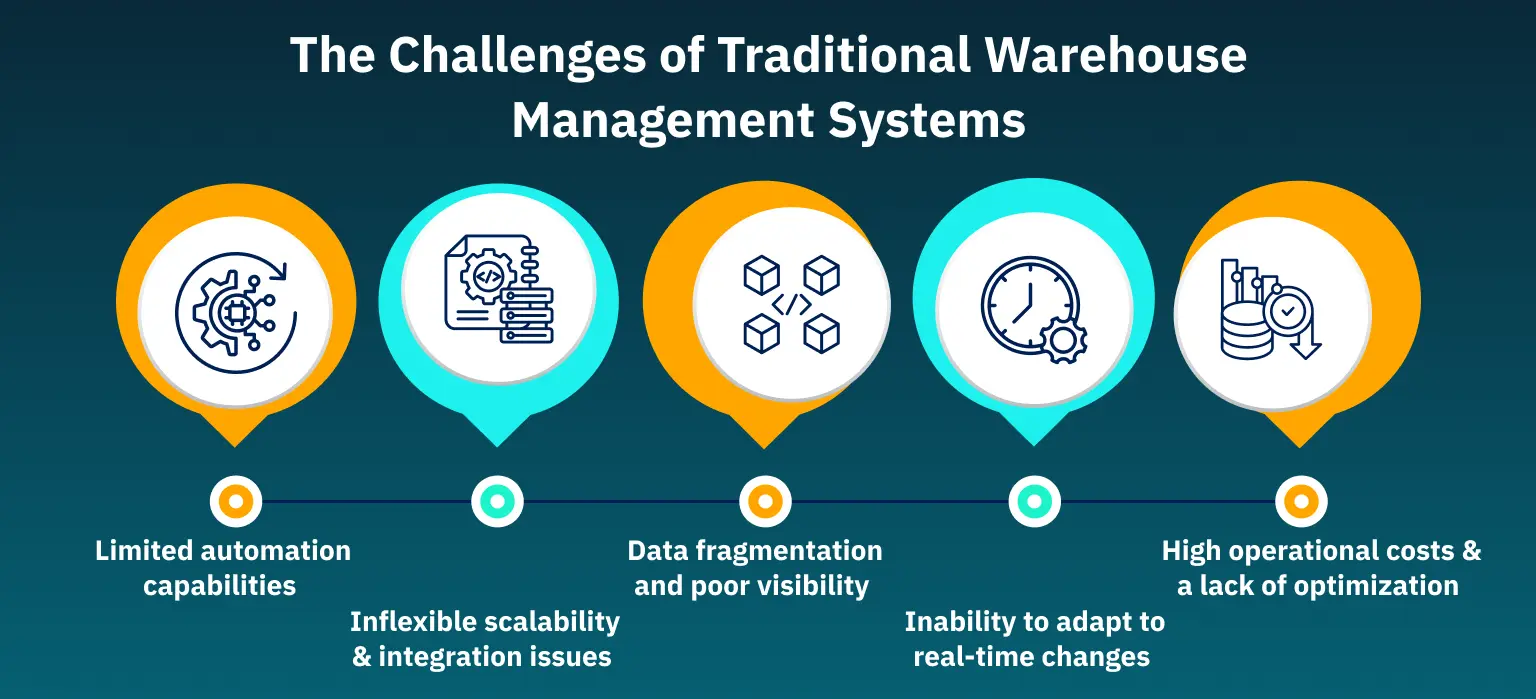
These challenges reveal the inherent limitations of traditional WMS in meeting the evolving needs of modern supply chains. To stay competitive, businesses must shift to custom WMS solutions that can address these pain points and provide the flexibility and scalability necessary for long-term success.
II. The Role of Custom WMS Solutions in Overcoming Warehouse
Challenges
Custom WMS solutions offer a strategic approach to addressing the challenges posed by off-the-shelf rigid systems. Businesses can tailor custom solutions to their unique needs, ensuring warehouses can operate efficiently, even as demands change.
Scalable WMS solutions tailored to business needs
Unlike fixed systems, a scalable custom WMS software can grow with the business, accommodating everything from multi-location warehouses to complex inventory workflows. This level of customization ensures that the system supports current demands while being adaptable to future needs.
Warehouse automation solutions that streamline operations
Custom WMS solutions bring warehouse workflow automation capabilities that streamline key functions such as order picking, sorting, packing, and shipping. By incorporating advanced automated guided vehicles (AGVs) or robotic systems, businesses can achieve faster turnaround times and reduce the risk of human error.
Moreover, custom WMS systems integrated with real-time warehouse data syncing and AI-powered analytics can dynamically adjust to demand fluctuations. The system can predict inventory needs, automatically trigger stock replenishment, and manage order flow without manual intervention. This enhances efficiency, reduces stockouts, and ensures that the warehouse operates at maximum capacity.
As businesses grow, their WMS must evolve to accommodate increased volumes, complex workflows, and technological advancements. The solution lies in designing a scalable, API-first WMS that offers seamless integration, real-time inventory tracking, and a modular WMS architecture to ensure long-term growth and efficiency.
III. Designing Scalable and API-First WMS Solutions
Here’s a breakdown of the critical features to keep in mind:
- Real-time inventory tracking
Real-time inventory tracking ensures that all stock levels, movements, and order statuses are continuously updated. It enables warehouses to make informed decisions based on current data, prevent stockouts and overstocking, and streamline order fulfillment. - API-first architecture
Designing with an API-first approach ensures that integrations with ERP, TMS, and ecommerce platforms are effortless, scalable, and flexible. It allows for smoother data exchange across systems through real-time warehouse data syncing, visibility, and coordination across the entire supply chain.
- Modular design
A modular WMS architecture provides the flexibility to add or remove functionalities as a business grows. Whether it’s adding new warehouses, adopting automated picking technologies, or integrating advanced warehouse data analytics, the system should be adaptable to meet evolving operational needs without requiring a complete overhaul. - Automation and workflow optimization
Integrating warehouse workflow automation solutions is key to improving efficiency and reducing human error. Features like automated order picking, sorting, and inventory management minimize labor costs and speed up order fulfillment. Automation ensures consistent accuracy, faster processing times, and better resource utilization. - Real-time data synchronization
Whether it’s inventory data, shipping statuses, or order information, real-time data synchronization ensures that all stakeholders have accurate, up-to-date information at their fingertips. This minimizes delays, reduces errors, and enhances decision-making. - Customizable dashboards and reporting
Customizable dashboards and reporting tools allow warehouse managers to track KPIs, monitor operations in real time, and generate reports based on specific metrics. Customization ensures the WMS aligns with unique business needs and provides the data needed for continuous optimization. - Scalability and future-proofing
A scalable WMS must be designed with future growth in mind. The system should be able to handle increases in order volume, additional warehouse locations, or new business processes without compromising performance. Cloud-based solutions can enhance scalability, as they allow the system to grow without needing costly hardware upgrades. - Compliance and security
As warehouses handle sensitive data, it’s critical to ensure that the WMS complies with relevant standards, such as GDPR or HIPAA (for healthcare-related products). Strong security protocols, such as data encryption and multi-factor authentication, should be implemented to protect both inventory data and customer information.
IV. How Integrating WMS with Core Business Systems Drives Efficiency
Here’s how these integrations optimize warehouse processes:
| Integration | How It Optimizes Warehouse Processes |
| ERP Integration |
|
| TMS Integration |
|
| Ecommerce Platform Integration |
|
| Real-time warehouse data syncing |
|
| Warehouse API Integration |
|
| Inventory Management System (IMS) Integration |
|
| Warehouse Automation Integration |
|
| CRM Integration |
|
While the benefits of integrating WMS with ERP, TMS, and other platforms are clear, the complexity of these integrations often requires more than just a technical solution. Businesses must ensure that each system is aligned with their operational goals, seamlessly connected, and able to scale as needs evolve.
This is where expert guidance becomes invaluable. A strategic approach, designed and executed by professionals, ensures that all systems work cohesively.
V. Achieving End-to-End Supply Chain Visibility with Matellio
When executed strategically, WMS integration can transform supply chain performance by connecting data, systems, and processes into a unified ecosystem. Matellio enables this transformation through tailored warehouse management software development that connects WMS with ERP, TMS, and ecommerce platforms.
Our API-first, scalable approach supports real-time data synchronization, automation, and visibility across the supply chain.
This approach was exemplified in our collaboration with MIXT Solutions.
Case Study:
Streamlining Operations for MIXT Solutions
Challenges
MIXT Solutions is a rapidly growing e-commerce consultancy and full-service Amazon partner. They were facing several issues with their existing inventory management system Extensiv.com:
- System Performance Issues: The Legacy system suffered from page load times exceeding 20 seconds and frequent downtimes (30+ outages daily lasting 1-5 minutes each), directly impacting order fulfillment and customer satisfaction.
- Escalating Costs: The subscription-based licensing model led to unsustainable cost increases as order volumes grew, with fees charged per order processed, eroding profit margins.
- Manual Process Burden: The business owner spent 2-4 hours daily on manual data management and insight extraction, limiting strategic focus and operational efficiency.
- Scalability Limitations: Monolithic architecture lacked customization capabilities and couldn’t adapt to evolving operational workflows, restricting business agility.
- Multi-Channel Sync Delays: Inventory synchronization across platforms took over 24 hours, creating overselling risks and stock discrepancies.
They approached Matellio as they wanted to replace Extensiv.com system with a scalable, cost-effective solution to support their growth trajectory while improving operational efficiency.
Solution
Matellio designed a comprehensive custom inventory management system featuring:
- Advanced Architecture: Microservices-inspired modular architecture with load balancing, auto scaling capabilities, and high-performance database structure with indexing and partitioning.
- Seamless Integrations: Native connections to Amazon, Walmart, Shopify, USPS, UPS, and FedEx, enabling unified operations across all channels.
- Automation Capabilities: Workflow automation reduces manual tasks, advanced ETL reporting pipelines, and real-time data processing for actionable insights.
- Scalable Infrastructure: Unlimited virtual warehouse support and future-proof architecture supporting continuous growth.
- Reporting Engine: Actionable dashboards and custom ETL pipelines enabled decision-making powered by real-time KPIs.
- Data Accuracy: Error-prone manual reconciliation was replaced with system-verified, low-latency reporting and validations
Impact
The transformation delivered remarkable results:
- Performance Gains: Amazon order pull time reduced from 60 minutes to 30 minutes; end-to-end shipping process reduced from 45 minutes to 30 minutes.
- System Reliability: Achieved 100% uptime, eliminating the previous 30+ daily outages.
- Operational Efficiency: 50%+ reduction in data retrieval time; 10 minutes saved per person per operational hour across 35 active users.
- Scalability Improvements: Bulk shipment capacity increased from under 100/day to 300+/day; multi-channel inventory sync improved from 24+ hours to near real-time.
- Cost Optimization: Transitioned from escalating subscription costs to a one-time capital investment with projected ROI within three years.
- Quality Enhancement: Achieved 0-2% error rate in order and inventory data; shipping errors reduced from 20+ per day to fewer than 1 per day
By combining domain expertise with robust integration capabilities, Matellio delivers solutions that enhance efficiency, visibility, and scalability across the modern supply chain.
VI. The Future of Scalable WMS
The rising demand for efficient, adaptive warehouse management is driving rapid innovation. Emerging technologies such as AI, IoT, and blockchain are redefining how warehouses function and scale.
- AI and Machine Learning: AI enhances decision-making by predicting demand shifts, optimizing inventory levels, and improving operational precision. With data-driven insights, warehouses can respond faster to changing conditions and improve fulfillment accuracy
- IoT integration: IoT connects assets, equipment, and inventory through real-time data capture. Sensors track movement, monitor environmental conditions, and support automated workflows, improving visibility and maintenance efficiency.
Suggested reading:
https://www.matellio.com/blog/iot-based-warehouse-management-system/
- Blockchain for transparency: It strengthens data security and traceability by providing a shared, tamper-resistant ledger for transactions and shipments. It promotes trust, compliance, and accountability across supply chain partners.
Beyond these technologies, cloud-based SaaS WMS platforms are emerging as the foundation for scalable operations. They offer flexibility, faster deployment, and lower infrastructure costs, helping businesses adapt to shifting market demands with minimal disruption.
A scalable, modular WMS architecture gives organizations the agility to expand, integrate new technologies, and evolve continuously, supporting sustainable growth in an increasingly dynamic supply chain environment.

Key Takeaways
- Traditional WMSs are falling short, lacking the automation and flexibility needed to meet modern supply chain demands.
- Custom, scalable WMS solutions give businesses the agility to grow and adapt without being held back by rigid systems.
- API-first WMS seamlessly integrates across platforms for smoother data exchange and easier system expansion.
- Warehouse automation speeds up processes and minimizes human error, making operations faster and more efficient.
- Real-time warehouse data syncing ensures accurate inventory levels and streamlined decision-making, reducing delays and mistakes.
- Technologies like AI, IoT, and blockchain are set to revolutionize WMS by improving operational efficiency, enhancing security, and providing deeper insights for more intelligent business decisions.
FAQ’s
Warehouse API integrations connect WMS with other systems (ERP, TMS, and ecommerce), ensuring smooth data flow. This enhances real-time visibility, inventory accuracy, and operational efficiency, while allowing for easy scaling as business needs evolve.
Best practices include using cloud-based architecture, prioritizing API-first design, and incorporating modular components. Ensure RFID or IoT integration for accurate, real-time tracking, and implement secure data synchronization to maintain reliability.
API-first design allows WMS to integrate seamlessly with ERP, TMS, and ecommerce platforms, reducing manual work and errors. It supports real-time warehouse data syncing, improves visibility, and accelerates decision-making to enhance operational efficiency.
Automation streamlines tasks like order picking, inventory management, and shipment processing, reducing human error and speeding up operations. It enhances fulfillment accuracy, reduces costs, and improves overall efficiency.
Integrating WMS with ERP, TMS, and ecommerce platforms provides real-time updates on inventory, orders, and shipping. It streamlines workflows, reduces delays, and strengthens decision-making for better supply chain coordination and customer service.
References:
- Markets and Markets, Warehouse Management System Market
- Business Insider, Amazon’s robots could help it save $10 billion a year by 2030, Morgan Stanley analysts say